#1

#2

#3

#4

Please select one of the following:
A. #1
B. #2
C. #3
D. #4
E. All of the above
F. I decline to vote until I have tasted one of each
Grazie for participating in the survey. Ciao.


 Getting lost, or at least wandering off the main path, is a good way to experience more of Italy. It can be a bit challenging, like the first time Cheri and I arrived in Venice. While searching for the hotel we managed to lose each other. Mark Twain wrote about one night getting lost in Florence while trying to make his way back to his hotel. After about four hours of wandering he enlisted the aid of a young soldier to help him find "Hotel d'Europe." Twain wrote, "We walked a hundred or a hundred and fifty miles, it appeared to me, and then he got lost."


 Finally, over 150 years ago a cedar seedling somehow made its way to the top of an abandoned tower, somehow found a patch of dirt to survive in, and somehow continues to grow to this day. The tower is hollow on the inside, so the tree lives a solitary but peaceful existence. Ciao.
 Climbed to the summit of Mount Subasio today. This picture was taken just a little above Assisi. Our apartment is to the right of the tower in the middle of town. The higher structure on the right is an old fortress. Santa Maria degli Angeli is on the top left. Great hiking weather, probably high 30's to the top. Incredible Umbrian views with snowcapped mountains in the distance. The lower part of the trail is forested, the higher part is mostly rugged, rolling hills, steep enough to ensure a good challenge. Just beautiful views in every direction. Here's me standing at the summit.
 Temperature warmed to the 60's on the way down. One interesting site was a group of horses gathered on the top of a high knoll. There's plenty of pasture surrounding the knoll, so it's hard to understand why they would all move to the top. Maybe to catch the first rays of sunlight? Maybe to enjoy the views? Maybe only one horse was up there and the others decided to be neighborly?
 "Buon Giorno" greetings are commonplace beyond the edge of town, and maybe a few added friendly words. My favorite encounter was on a dirt road I was descending, when a guy came zipping up in his Fiat-like auto, lady-friend at his side, window wide open, one arm waving and hollering out a hearty, "BUON GIORNO!" as if to declare this one of the best days ever. Perhaps it is.
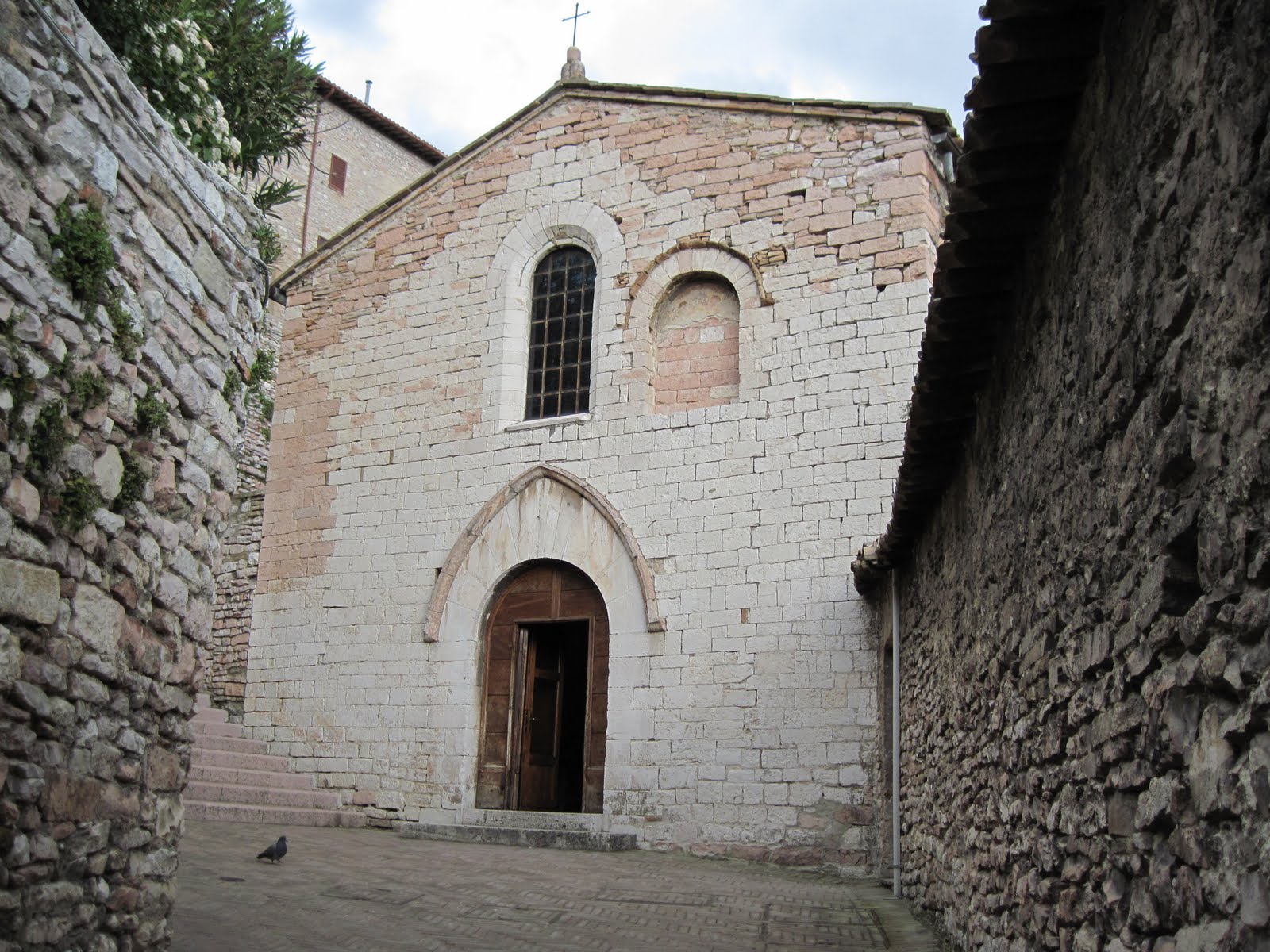


 Assisi is so peaceful. However, it hasn't always been that way. After the Romans replaced the Etruscans, who replaced the Umbrians, centuries of wars followed. San Rufino, who brought Christianity in the third century, was martyred by drowning. Barbarian invasions followed, and enventually Charlemagne's armies took over. In 1160 Frederick Barbarossa put Assisi under his jurisdiction. Additional changes of authority led to the establishment of the Commune of Assisi, which soon was waging an unsuccessful war against the neighboring city of Perugia (Francis, a participant, ended up in jail for about a year). When not fighting invaders, the nobility and the working class of Assisi took to fighting each other. At one point, the people of the "upper part of town" battled those of the "lower part of town." The centuries of sackings included a 1503 invasion by the troops of Cesare Borgia. In the early 1800's came the troops of Napoleon, but I'll stop here, as it would take volumes to cover all of the conflicts. One can only hope that all places where war is now being waged eventually become as peaceful as Assisi.

Next is the historic Temple of Minerva. The columns were put in place by the Romans over two thousand years ago. A few centuries later it was converted (so to speak) into a church. The steps are a nice place to sit on a sunny day. Here is what a properly flowered front door should look like.

 Ciao.
Ciao.