Sunday, April 17, 2011

Finding Sasso Rosso

Early on Palm Sunday morning I went searching for Sasso Rosso.  One might well ask, "What's Sasso Rosso?"  According to numerous websites, "Castle Sasso Rosso ('Redrock') on the slope of Mount Subasio was the site of Saint Clare of Assisi and Saint Agnes of Assisi' childhood since according to tradition they were the daughters of Favorino Scifi, Conte of Sasso-Rosso, the wealthy representative of an ancient Roman family, who owned a large palace in Assisi as well."  That was eight centuries ago.
While many writers mention this red rock castle as being where Saint Clare spent part of her childhood, an internet search for images of Sasso Rosso produced little beyond general pictures of Subasio and Assisi.  Certainly an old castle can fall to ruin over so much time, but disappearing completely seems not likely.
A detailed topographical hiking map of Subasio was helpful in determining where Sasso Rosso should be, or should have been.  It would involve about a two hour walk up country roads before breaking off on a narrow hiking path.
Why set out on Palm Sunday?  Because it was on the night following Palm Sunday in 1212 that Chiara, or Clare, set out secretly from her parent's home in Assisi to follow in the footsteps of a man named Francesco, or Francis, whose humble life would have much impact on the world.
On Palm Sunday, 2011, just after 6:00 a.m., the streets of Assisi were tranquil and empty.  I passed no one walking out of town, or following the country roads that gradually led up into the forests of Subasio, eventually turning onto the narrow trail.
An opening provided a glimpse of the landscape below.
Then, according to the map, the site of Sasso Rosso.
Climbing up a few steps led to a rectangular-shaped opening.  It's clear that much of Sasso Rosso is a natural rock formation.
Then, upon closer inspection, signs of a long-ago structure.
Crossing over to the other side reveals more.
Drawing closer.
Red rock remains of the past.
As a youth, Clare must have enjoyed the inspiring views from Sasso Rosso.
Clare, following Francis in his dedication to poverty, founded an order of nuns known today as the Poor Clare Sisters.  There are more than 20,000 Poor Clares serving in at least 70 countries around the world.

Ciao.

Friday, April 15, 2011

Assisi Visitor

Simone Weil visited Assisi in 1937.
“When I got to Assisi, Milan, Florence, Rome and all the rest completely disappeared from my memory, so captivated was I by the gentle landscape, so miraculously evangelical and Franciscan, by the delightful churches, by a wealth of happy memories and by those noble examples of humanity- the Umbrian country folk, rich in beauty, physical strength, joy and kindness.

Little had I dreamt such a marvelous place existed. I would have stayed for the rest of my life – if only women were accepted - at the tiny monastery of the Carceri, an hour and fourteen minutes walk up the mountainside from Assisi. No more heavenly and tranquil sight exists than Umbria as seen from up there. Saint Francis certainly knew how to choose the most ravishing spots to practice poverty: He was far from being an ascetic….”
- Simone Weil

The Eremo delle Carceri.
View from the Eremo.
Assisi, looking up from in front of the Basilica of Saint Francis to the small Church of Santa Margherita
Ciao.

Wednesday, April 13, 2011

Walking About Mount Subasio

Yesterday some fine Spring weather provided an opportunity to attempt a long time goal of walking around Mount Subasio.  Generally, one thinks in terms of climbing mountains, and the summit of Subasio is a good trek.  Many interesting trails weave over and around the mountain and its foothills, providing beautiful views of the blossoming countryside.  However, yesterday was a day for walking around rather than up and over. I hope to write more about the day later.  For now, here's a few pictures of places visited along the way.  First, starting out early from Assisi, looking over the valley.
 The next town has the interesting name of Costa Di Trex.
The country road the leads to an old town called Armenzano, with close, interesting pathways.
Although there's very little traffic, one must be alert for rockslides from the mountain.  If an avalanche doesn't clunk one on the head, there's always the possibility of a passing vehicle finishing the job.
Next was San Giovanni, and then the charming town of Collepino, as seen from afar.
And along one of its streets.
In many places the roads are lined with Olive trees, so beautiful in the springtime.
At last, the ancient town of Spello is in sight, most of the way around the mountain.
More interesting streets to explore.
A typical Spello store. 
A fountain for refilling my water bottle, below an ancient aquaduct.
Still plenty of walking to do.
One sees many small shrines along the roads.  This tile is part of one on the way from Spello to Assisi.
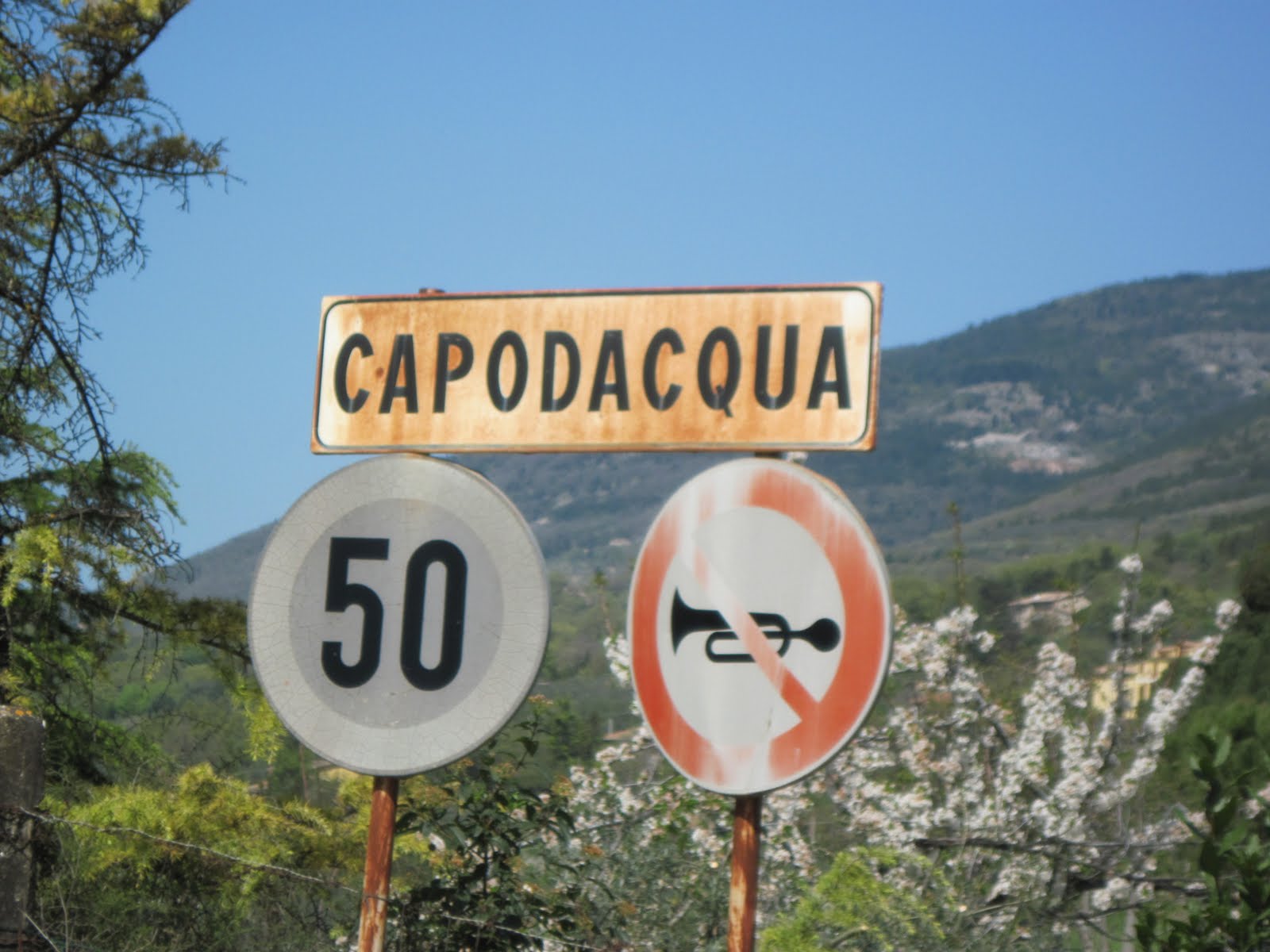
Please, when passing through Capodacqua, obey the speed limit and do not toot your horn!
At last, a gate back into Assisi.
The walk around Subasio, including exploring towns, was about 25 miles.  Ate a very large plate of spaghetti for dinner last night.  Interestingly, walking so close to the foothills meant barely glimpsing the summit.  However, on my way down to Santa Maria degli Angeli this morning, I looked backed up and saw the top of Subasio covered in white from an overnight snow.

Ciao. 

Monday, April 11, 2011

Cinque Terre - Five Lands

Cinque Terre has wonderful walking paths, through the towns, along the coast and up into the hills and mountains.  Northernmost is the resort town of Monterosso al Mare, with a long sandy beach.
Next is Vernazza
Vernazza and each town have many interesting walkways.
Continuing south is the smaller, quieter Corniglia, built up from the sea on a rock outcropping.
Cornelia has quiet back streets,
opening out to sea views.
Next is Manarola, our Riomaggiore neighbor, with boats on the main street.
And artistic details on the steps.
A very pretty town, as they all are.
The coastal trails are narrow and sometimes closed due to landslides or potential slides.
But even during rough seas, some will dare venture down for a picture.
The surrounding hills provide many interesting paths.
The mountain trails also are subject to landslides and other possible surprises.
But high up on the mountains the trails are quite tranquil and easy to traverse.  
A fine place to visit in the Spring.
Ciao.

Sunday, April 10, 2011

Cinque Terre - Riomaggiore

Buon Giorno.  Haven't posted for a while as we just spent nine internet-free days in Cinque Terre (Five Lands, consisting of five towns, the surrounding hills and the sea) on the northwest coast of Italy.  The flowers above were just one treasure of the town we stayed in - Riomaggiore.  Looking down from above:
This area was first settled well over a thousand years ago.  Over the centuries, the hillsides were terraced with stone walls to allow planting of grapes, olives and other crops.  Although I doubt the distance between the five coastal towns totals more than ten miles as the crow flies, the stone walls, weaving up into the mountains, if stretched end to end would extend the distance across North America.  We arrived by a local train, which tunnels underground then comes out at each town.
Our apartment was on the main street of Riomaggiore, Via Colombo.  That's it in the middle of the picture, blinds open, white curtains, just below our neighbor's full clothesline. 
It was a fine place.  Here's a view looking up the street from one of our windows.
And looking down at a stand of fresh local fruits and vegetables.
Just walking about town in Riomaggiore affords many wonderful views.  
 Plenty of steep steps to climb, but not without rewards.
Naturally, this region also has long depended on fishing for much of its food.  While the area has many visitors, farming and fishing continue to be very much in evidence.
The green hills and blue sea and sky are complimented by the soft, worn colors of the town.
From Riomaggiore as the sun is setting.
Ciao.