Sunday, May 1, 2011

Calendimaggio

Not long after Easter in Assisi is Calendimaggio, a traditional celebration of spring.  Many Assisians dress in period costumes and participate in the festivities, which include singing, parades and competitions.  Not to worry if clouds appear, the main street is covered.
Pre-Calendimaggio actvities include bows and beauty.  First, the bows, or rather crossbows, precise instruments, with fine crafted wood and even steel cables. 
The Parte de Sopra (upper town) squares off against the Parte de Sotto (lower town) in a competition of accuracy.  But first, a parade!
The archers make their way into the large piazza in front of the Basilica of Saint Clare.
A closer look as they come around to where the competition will begin.  The targets can be seen about forty or fifty yards away.
The accompanying marchers step back. 
The Parte de Sopra lines up to await their turns. (note - by fate or fortune we live in a Parte de Sopra neighborhood.  We cheer for the others at the risk of losing our lease :-)
At last, the competition is underway.
The competitors shot with amazing accuracy.
Hitting those small, distant white targets, sometimes in the center.
Time to move to other kinds of bows, from arrows to a rose (sorry), to a pageant of beauty.
The contestants are presented.
 Parte de Sopra on the left, Parte de Sotto on the right. (Don't you prefer the pastels to the red?)
Following the pageant, people prepare for another parade.
This flag is the symbol of the Parte de Sopra.
The parade continues with music.
And wonderful costumes.
More flags.
 Some serious drumming.
Didn't need those umbrellas after all.
Ciao.

Friday, April 29, 2011

Pieve San Nicolo

If one stands at the small piazza in front of Chiesa Santa Margherita overlooking the great Basilica of Saint Francis, one's eyes are drawn to the northwest and the idyllic Umbrian countryside extending up into the mountains.  It's a land of orchards, farms and forests.
Recently I walked up a road along a ridge to the left of the above region, intent on finding the distant community of Pieve San Nicolo (pop. 26).  Looking back provided some wonderful views of Mount Subasio.
After a wonderful morning stroll the nice hamlet of Pieve San Nicolo came into view.  The main structure seemed to be a church with a road curving up to it. 
On the front of the church was a poster asking the question (forgive my loose, freelance interpretation), "When does one find the time for God? (1) Too young to think of God.  (2) Too sure of oneself to think of God.  (3) Too tired to think of God.  (4) Too happy to think of God.  (5) Too busy to think of God.  (6) Too late to think of God." 
Across the road from the church was a vociferous, but friendly, dog.  His world consisted of a small fenced area which he shared with a propane tank, his little house, and flowers all about.  His job, it seemed, was to announce to all of Pieve San Nicolo that a visitor was about.
The day's real adventure began early on the way back,when I picked up a trail that runs from Assisi to Gubbio, a pathway that Francis followed.  A sign told a story, written in Italian and translated into English.  While the English translation may seem a bit rough, in truth it captures some of the expressive beauty of the Italian language.
In one of the most cold winters of San Francesco's youth he went far from Assisi without plan(n)ing before any important travel such as this, but it happened that he went through the road to Gubbio.  A friend, who San Francesco did not see for a long time, offered him hospitality in Gubbio.  The permanence of the saint in this town permitted him to consider himself under a wider light his commitment toward the suffering lepers and the excluded people from the society.  The path from Assisi-Valfabbrica-Gubbio is strongly dominated by San Francesco's spirit travel, which is represented by the chronicle described in the actual itinerary that is cor(r)espondent to the medieval road network.  People can become themselves as part of the nature and art of the path, which are Sa(n) Francesco's maturity essential aspects.  For instance, his love for creation and consciousness are part of the "church" community, and his continuous research in the peregrination is a fundamental element of stability and an achievement of the Christian "order".  The uniqueness of this path is to make us remember the Franciscan message in comparison to Francesco's suffering and cheerful life. 
Wonderfully, this path not only traces Francis' steps, it also passes through the countryside of the top photo.  Leaving the main road behind, first came a rocky path, then a string of rural roads.
The way was well marked.
And beautiful.
With signs of spring.
And interesting views of Assisi from a less travelled direction.
Finally, back up to town, after about a twelve mile walk.  Ciao.

Wednesday, April 27, 2011

Perugia

Yesterday, we took a bus ride to Perugia, a somewhat larger Umbrian city, home of the delicious Perugina chocolates, and an ancient rival of Assisi.  We rode through Collestrada, where a young Francis fought against Assisi's rival, was defeated, captured and imprisoned in a Perugian jail for a year. 
Perugia sits high on a hill.  Several years ago escalators were built to carry people up to the old part of town, passing through Sixteenth Century underground ruins on the way.
From there we walked along Corso Vannucci, a beautiful, wide old street, kept free from traffic, that takes one past many of Perugia's well preserved old buildings.
At the center of the above picture is Perugia's Duomo, or Cathedral of San Lorenzo, perhaps best described as "large" on the outside, but with an impressive interior.  Just before the Duomo is Fontana Maggiore.
Opposite the above is the Palazzo dei Priori, home of Perugia's city hall.  On the old Palazzo facade are a lion (for papal allegiance) and a griffin (for Perugia). 
In sorting out history, it's ineresting that a city loyal to the popes would vie fiercely with the the home of Saint Francis (although Assisi itself often was divided in it's loyalties).  Francis, thankfully, eventually opted for "pace e bene" (peace and goodness) over continued military pursuits.  
Continuing along we observed some interesting storefronts.
This one, with the name Faberge, was strictly for window shopping.
We also wandered some back streets.
And enjoyed some fine views.
Before making our way back to Assisi.
Ciao.

Sunday, April 24, 2011

Assisi Potpourri

In celebration of Easter, here's a diverse collection of pictures from around Assisi.  First a favorite statue of St. Francis near San Damiano.
Next, a glimpse through a window at the Eremo delle Carceri.
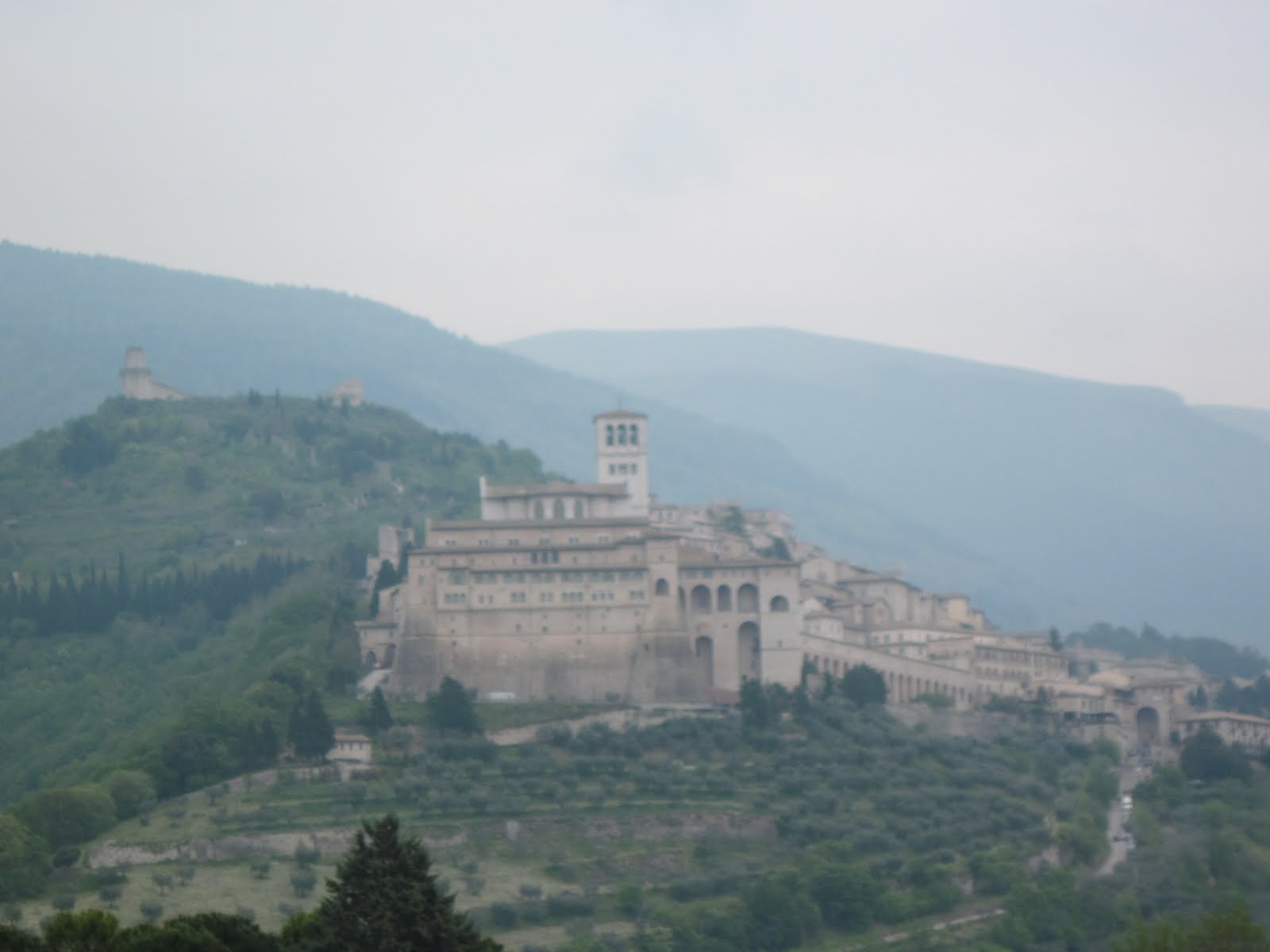
A view of Assisi from the west, that includes the Basilica of Saint Francis in the foreground and Mount Subasio in the background.
A view from in town, including the fortress of Rocca Maggiore. 
An Assisi street.
Smiles.
Recent artwork at the childhood home of Francis.
A portrait of Saint Clare, by an entryway.
Ruins atop Colle San Rufino, a rise on the way up Mount Subasio.  Bronze objects from about the Fifth Century B.C. have been found here.
On the side of the Colle are some ruins, the origins of which I have not yet learned.  They appear to be ancient stone walls and the remains of stone structures carved into the hillside.  Interestingly, what might have been a main room seems to have been turned into an impromptu shrine at some point in the past hundred years (or so).  Within a niche in the wall have been placed religious objects, pictures, etc.
Including Saints Francis and Clare.
Back in Assisi, an evening view of the Cathedral of San Rufino.  The structure immediately below the bell tower was Clare's childhood home.
A roadside scene at the nearby town of Tordibetto.
And flowers atop Subasio.
Ciao.

Thursday, April 21, 2011

Italian Health Food

Please study this picture.
Whether or not you are fluent in Italian, you may recognize this as gelato.  Funny how quickly we become bi-lingual under certain circumstances.  Gelato looks like ice cream.  However, in fact, they are differente.  You see, the gelato does not have the crema of ice cream, and thus has less grasso (fat) and fewer calories.  Thus, I think one may argue it is a healthier food.  What is health food if not food that is healthier? 
I refer you to the middle of the top row, to what is obviously the cioccolato (pronounced somewhat like chock-oh-latto, rolling easily off the tongue.... just as the gelato rolls easily onto the tongue).  The problem is, once one has tasted the cioccolato, what conceivable reason would one have to try any other flavor?  It is a dilemma (trans. "dilemma" - see, you are bilingual).  However, the flavor to the right of the cioccolato consists both of cioccolato and other good ingredienti.  How is one to resiste?  For one who has tasted them both, but one word remains to be translated.
Delizioso! 
Ciao.