Saturday, March 2, 2013

Pitti Palace and Boboli Gardens

Before and during the Renaissance the Medici family gained much wealth and power through its banking interests. Back then, there were those who wished "to keep up with (or surpass) the Medici", among them another banker, Luca Pitti. Now, the Medici were wise enough to not flaunt their wealth (it was obvious enough); however, Luca Pitti was not. Legend has it he decided to outdo the Medici by building a very grand palace. Thus, in the mid-Fifteenth Century, construction of the Pitti Palace began.  Pity poor Pitti: this was probably not the first time an ambitious home builder got in over his head, and certainly not the last. Being in banking, you'd think he would have known better. Here's the front entrance.
Really not much to look at when compared with other Florentine architecture. Pitti moved forward for several years until he had financial difficulties. He eventually died, though the palace remained in the Pitti family until the mid-Sixteenth Century when a willing buyer appeared on the scene, none other than the Medici family. Actually, the new owner was Eleonora di Toledo, Duchess of Florence, wife of Cosimo I de Medici, who wanted a place for visiting guests to stay. In time the palace became the Medici residence, was more than doubled in size, and the Boboli gardens were developed as a rather opulent back yard. The view behind the palace:
The interior of the palace now houses several museums, with a wealth of art and other Renaissance treasures.  During winter the Boboli Gardens appear as most gardens in winter, with the exception of some rather substantial garden ornaments.  Here are some water statues.
Here they are from a distance.  Neither the statues nor the bird seem to move very much.
Here's a nice cypress lined walkway.
 
A rear view of the palace.
Even on a chilly day, at least one visitor was having a grand time with so much room to run about.  A plus of a winter visit is the absence of crowds.
Behind a wing of the palace a couple of lions appear to be staring at each other, each with a paw over an orb, perhaps a globe, and perhaps reflective of the concerns that weigh on those with wealth and power.
Finally, leaving behind the treasures of the Pitti Palace, one finds across the way a pleasing contemporary discovery.
A shop specializing in teas and chocolates.  On that bright thought...ciao.

Friday, March 1, 2013

Bellosguardo

Over many centuries Florence has developed to the east and west along the Arno. However, to the north and south one can still find rural areas rich with natural beauty and history. To the north is Fiesole, high on a hill and well known for its charm and a past extending to Etruscan times. Many ride cars or busses or go on five mile treks to take in this pre-Florentine town.
Less visited but with comparable views is Bellosguardo, a small hill community south of Florence. On a hazy, overcast day limiting those views, I decided to walk up through Bellosguardo. The road started to rise passing through a nice neighborhood.
Nice for the most part; not sure how the neighbors must have felt when this corner room was added.  Perhaps it was there first.
Soon, the wall-lined road narrowed and started to curve sharply.  This is a two-way road, in theory.
Early on I noticed cars honking, then realized, as they approached each sharp turn, they would sound to warn drivers coming from the other direction. While the countryside here is lovely, when a few cars would appear simutaneously the experience of enjoying the (honk) scenery and the villas and gardens and the distant (toot) mountain views would fall a bit short of customary rural Italian tranquility (beep beep). Still, it's a good climb.
Florence could be seen through the haze.
One can discern the Duomo on the left and the Palazzo Vecchio on the right, but it was not a day for picture taking.
There is a small hamlet atop Bellosguardo, a hill with much history. Among the persons to have resided on Bellosguardo were Nathaniel Hawthorne, Henry James, Florence (named after the city of her birth) Nightingale and, perhaps most notably, Galileo Galilei, who lived near this piazza.
So, for future reference, Bellosguardo is best visited on a clear day. It is a modest uphill walk from the city, on a narrow, winding road. Those choosing to go there by car or Vespa are forewarned to drive cautiously and to you-know-what before every sharp curve.
Ciao.

Thursday, February 28, 2013

In Florence

After a long day traveling from California to Florence (21 hours, door to door), this first post will be just a few pictures taken while walking about town, tired but pleased to be here.  My apartment is in the San Frediano section of town, one of the best preserved parts of a very well preserved old city.
The apartment is on the third storey (Italians would say second floor) looking out over the street.  Very close by is the Cappella Brancacci, where Michelangelo went to study the works of Masaccio.  In addition to this section's art-filled churches, here one thinks of writers.  Florence, of course, was Dante's home (until he was exiled, to the future chagrin of Florentines).  However, also not far from the apartment are the lodgings where Dostoevsky wrote The Idiot.  And very close by is Casa Guidi, the home of Elizabeth Barrett Browning and Robert Browning.  Just inside the entryway of Casa Guidi is a quote by the latter.
In Florence one is surrounded by art, and not just in the museums and churches.  Came upon this chalkwork on a busy street.
Unfortunately, vehicles were already driving over it.  Perhaps less fleeting will be this doorhandle... or handdoordle.
Hmmm, one seems to be treated more amiably on the way out than on the way in.  Speaking of doors, how about a panel from Ghiberti's doors of the Baptistry, referred to by Michelangelo as the Gates of Paradise.
(Note: after many centuries, the outdoor panels are fine copies, with the originals in a nearby museum.)  Time for a glimpse of the Baptistry, the Duomo, with Brunelleschi's dome, and Giotto's Campanile, or bell tower.
Just one more door, here's the very beautifully detailed main entrance to the Duomo. 
This is a view of Ponte Vecchio, the old bridge. 
Finally, one can hardly help reflecting on how well Florence and gelato blend together.
Grazie e ciao.
Friday, February 22, 2013

Italy 2013

In late February 2013 I'll be arriving in Florence.  Will be there for a month, then in Assisi for most of April, followed by travels to Venice and beyond.  Hoping to do regular posts, sharing some of Tuscany, Umbria and Venice in the springtime.  Pace e bene!

Friday, August 24, 2012

Assisi Walking Adventure Guide

For those who have enjoyed reading about Assisi, Mount Subasio and Umbria, I have recently published an ebook entitled Assisi Walking Adventure Guide.

It can be downloaded for free at https://www.smashwords.com/books/view/217714.
Anyone considering a trip to Assisi may find it quite useful.  Whether you're headed to Italy, or just dreaming about it, buon viaggio!

Saturday, May 5, 2012

Assisi Diary - Day 44 - Arrivederci

Tomorrow begins the long trip home, a ride to Rome, a following day flight to Washington D.C., then on to California.  About a 40 hour trek, door to door.
Thanks for following my travels; hope you enjoyed the words and pictures about Umbria. 
Pace e bene.
Arrivederci e ciao.
Friday, May 4, 2012

Assisi Diary - Day 43 - Mountain Views

Today was an ideal day for hiking on Subasio, crisp and cool early, with a gentle wind higher up when the sun started warming.  Visbility was excellent; I would guess about 100 miles looking at the distant Apennines.  One could see individual houses across the valley about ten miles away.  I kept a good pace and, starting at Porta Cappuccini, reached the summit in about two hours and fifteen minutes.  Along the way I encountered three horses "outside the fence", enjoying the gourmet growth along the side of the dirt road.  They each eyed me warily then, without prompting, quickly made their way back through a break in the fence, as if not wanting to be held responsible for being where they weren't supposed to be.
From the summit I made my way over to the largest sinkhole, Mortaro Grande, which can be seen here from a distance.
Here's a closer look at the inside.
From there I continued along high on the mountain, enjoying distant views.  Bettona is on the first rise across the valley; Assisi is just out of sight below to the right; Rome is just over the distant horizon.
Came across some fair areas of wildflowers.
Some quite colorful.
The trail down was the one I had ascended several years ago on my first Subasio climb.  Many hikes later it is no less wonderful and no less an adventure.  There is so much to explore on the mountain, both in natural beauty and historical sites, that one could spend a year wandering here and not tire of it. 

Ciao.


Thursday, May 3, 2012

Assisi Diary - Day 42 - Odds and Ends

Things are busy around town in preparation for today's opening of Calendimaggio.  The Piazza del Comune will be cordoned off for the main events.  Crossbow targets have been set up at the end of the piazza, stands have been assembled and those restaurants with outdoor seating have moved indoors to provide more room.

Most Assisi streets are narrow and one-way.  If urban planners had any forsight about automobiles during Roman times or the Middle Ages, they didn't follow through.  Here's what happens when a local bus tries to get by a construction truck.
With a little coaxing, and folding in the passenger side mirror, the driver made it through without a scratch.

Went to mass in Santa Maria degli Angeli this morning.  It's amazing the numbers of pilgrims around the world who travel to visit the Porziuncola.  Also amazing is the numbers of religious orders in and around Assisi.

By the way, in writing I've often used the words "monastero" and "convento".  In the U.S. one typically thinks of monasteries as being for monks, convents for nuns.  However, in Italy typically a "convento" will be home to Franciscans or Dominicans, while a "monastero" will be home to Benedictines, Carthusians or Cistercians.  One may be tempted to think that Assisi would be simply filled with Franciscans, but that would be forgetting that this region had many large Benedictine monasteries before and during the time of Francis.

And this sunny afternoon, it was decision time.
Chocolate and coffee prevail, again.

A few more flowers.
  Ciao.

Wednesday, May 2, 2012

Assisi Diary - Day 41 - San Silvestro

Took a long walk today around Subasio to see the Abbey of San Silvestro, which sits well up above the town of Collepino.  Much of the morning was foggy, which made for good hiking and interesting trails.
After about a three hour walk over diverse roads and trails I came upon the church, which has an origin of being a hermitage founded by Saint Benedict in the year 523.  In 1025, the then abbot, who became Saint Romuald, dedicated a church there to Saint Sylvester.  Over time much of the church was destroyed, but was eventually restored.
Apparently the apse is the original, going back to the 11th Century or earlier.
In the interior of the apse are the remains of a 15th Century fresco of the Madonna and Child Enthroned.  Interestingly, a 3rd Century Roman sarcophagus was used as the altar.
The grounds currently are nicely cared for by a group of nuns calling themselves The Little Sisters of Mary.

My return route gave me an opportunity to revisit Gabbiano Vecchio, the abandoned town deep in the forest that I wrote about a few days ago.

Ciao.

Assisi Diary - Day 40 - San Quirico and Decorative Doorknockers

Attended mass at the Monastero delle Clarisse di San Quirico (convent of Poor Clares) this morning.  The monastery is 15th Century, although the interior of the church is clearly more recent. (Saint Quirico was a child, martyred with his mother, in the year 304.)

Since today has been spent around town, thought I'd have some fun posting some of Assisi's more illustrious doorknockers.  Many are nicely designed and functional, similar to this one.
However, some might make you think twice before knocking.
Some have ancient origins.  And why go Etruscan when you can have Egyptian?
Wonder if this is the home of a hair stylist?
Time to move on to the top three.  In third place, for its pleasant and welcoming demeanor, is this friendly and unassuming work.
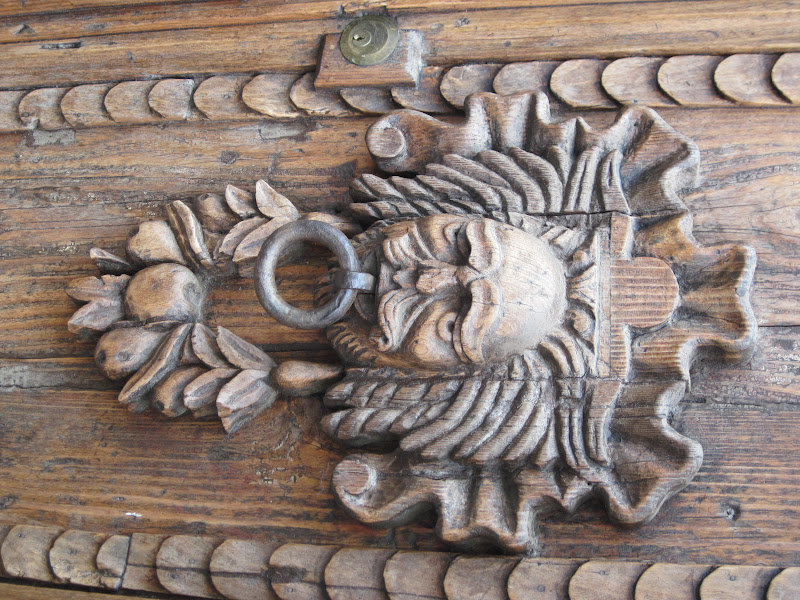
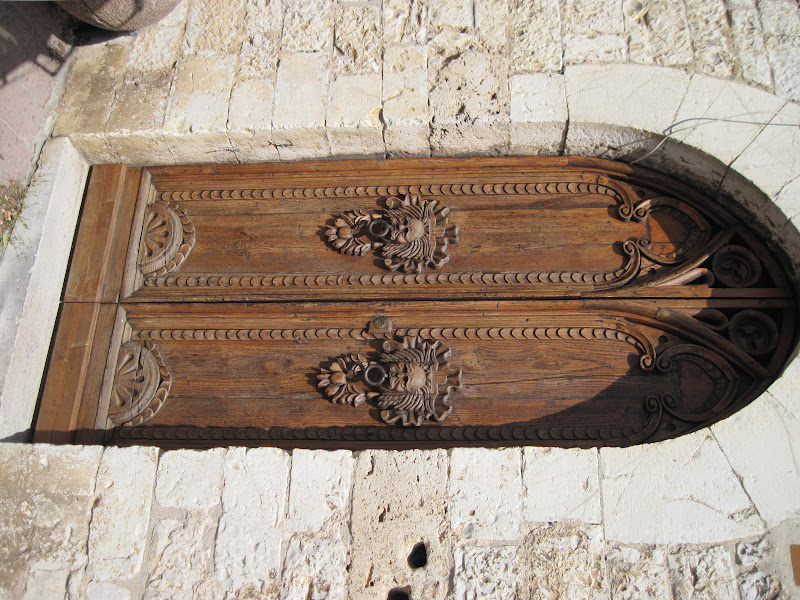
Second place goes to the other extreme.  Not exactly pleasant, welcoming, friendly or unassuming, but you have to be impressed by a doorknocker that looks you straight in the eye.  Someone put a lot of work into this, probably a long time ago.
Furthermore, it has a twin.
Okay.  Time to move on to #1.  First, I'll disclose that I found the winner outside of the gates of Assisi in Santa Maria degli Angeli.  This may elicit a protest from the owner of second place Tweedledee and Tweedledum, but someone was bound to knock my choices.  In any event, #1 really deserves a hand.
Of all the doorknockers, this one is perhaps the most tempting to draw back and follow through with a few good raps.  Just what doorknockers are for.

Ciao.