Friday, March 22, 2013

More on San Miniato al Monte

Here are a few more pictures of the church of San Miniato al Monte, described in an earlier post. It is considered one of the most beautiful churches in Italy. First the brilliant upper part of the facade, with the eagle on top symbolizing Florence's cloth merchant guild.
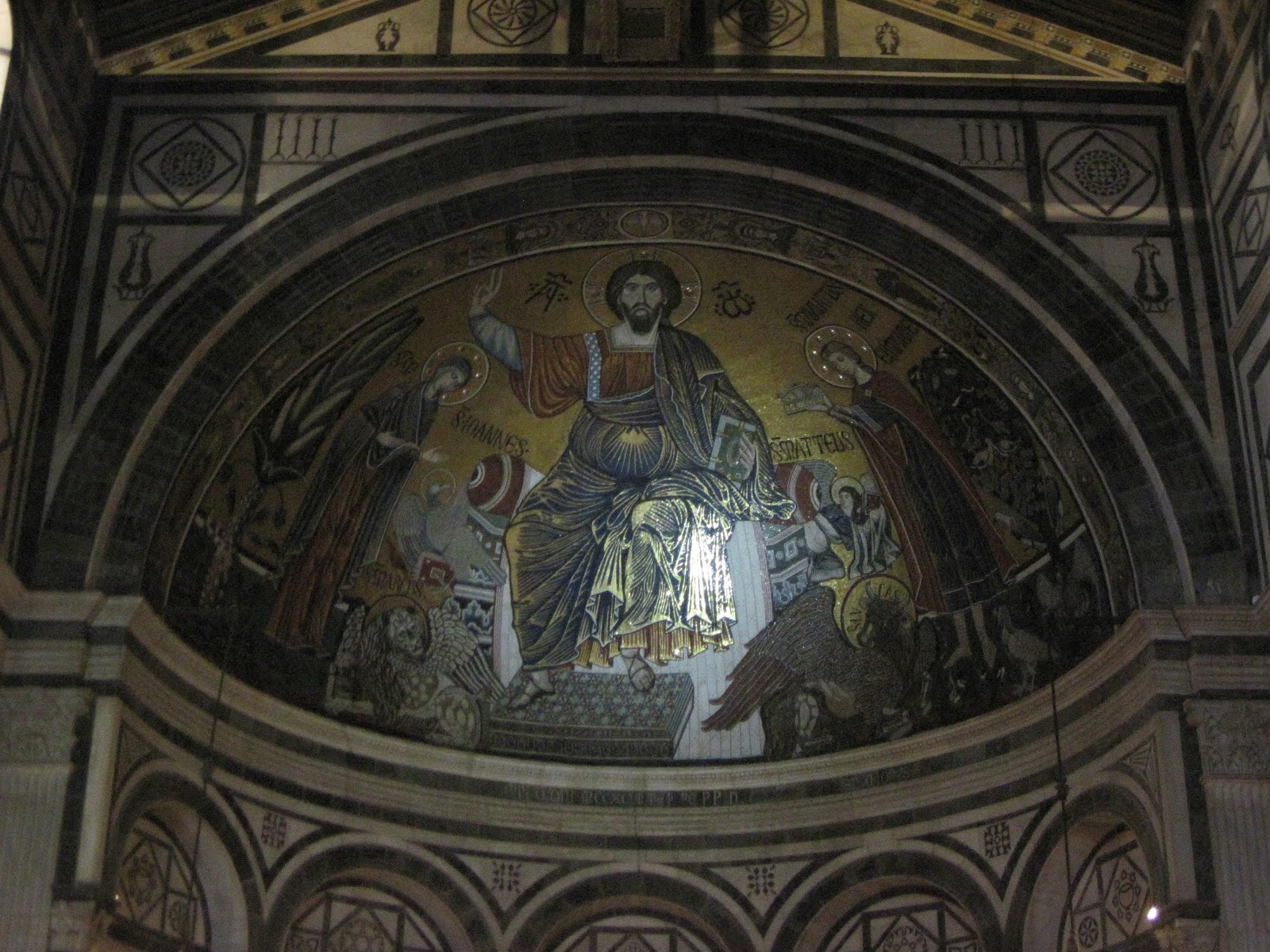
Next, the interior, which includes a choir over a crypt, constructed over 800 years ago. (Sorry about the limited early morning light.)
The mosaic work over the upper altar portrays Christ between Mary and Saint Minias.
The work below is on a wall near the entrance. While knowing no details, it appears to be the Virgin and Child surrounded by several saints, and is perhaps six centuries old.
Gregorian Chant is still sung at San Miniato al Monte. Being high on a hill away from the city center, it is less visited than Florence's major churches, but is no less special.
And goodness nose is no lie that interred in the cemetary behind the church is Carlo Collodi (Lorenzini), the creator of Pinocchio.
Finally, one can hardly improve on the views from San Minato al Monte.
Ciao.

Thursday, March 21, 2013

A Little Florentine History

This is the stair landing outside of the door of my apartment in Florence.
Not much to look at, save for one interesting fact that I'll share in a moment.
My landlord's last name is Berti. Aware of it being an old Florentine name, I asked him about it, especially about a reference to a Berti in Dante's Divine Comedy. The following is from the Paradiso, Canto XV (Longfellow trans.).
Bellincion Berti saw I go begirt
With leather and with bone, and from the mirror
His dame depart without a painted face;
(The lines refer to a period of time when Florentines dressed modestly. Elsewhere Dante refers to Bellicion's daughter, "the good Gualdrada.")
As it turns out, my landlord is a descendant of the Berti family of Dante. He shared more of his family history, how his ancestors came from the north and played a prominent political role in Fiesole, the town north of Florence that goes back to Etruscan times. During Dante's time the Berti family provided arms (swords, daggers, etc.) to the Florentine Republic.
As for the stair landing, it has not changed since the Fourteenth Century (Dante lived until 1321). People were passing over these same stones before Columbus set sail.
To balance the plainess of an old stair landing, I'll leave you with a more heavenly picture from my morning walk.
Ciao.

Wednesday, March 20, 2013

Lucca - Part II

Much like Siena and Assisi, Lucca is a fine town for just wandering about. It's difficult to get very lost surrounded by a forty foot high perimeter wall. Or one can pick up a map at information offices near Porta Santa Maria or Piazzale G. Verdi.
As with those other towns, much of Lucca's history, art and architecture are to be found in her churches. Here's a glimpse of a few of the more well-known. This is the facade of the Cathedral of Saint Martin, Lucca's Duomo. Although most of the facade is newer, the church was begun in 1063.
Below is the facade of San Michele in Foro, a basilica so named because it was built on the site of Lucca's Roman Forum. The church's origins date back to at least the Eighth Century, although much of it is newer. Inside is a beautiful painting of four saints by Filippino Lippi.
Here's a closer look at the top part, showing Saint Michael the Archangel.
Next is the interior of the Basilica of San Frediano, which had its beginnings as a Sixth Century church named after Fridianus, who was the son of a king of Ireland and a bishop of Lucca. (I've been staying in the San Frediano neighborhood of Florence, a good Irish-Italian combination.)
The church was built up in the Twelfth Century, and the facade developed over the following two centuries.
Note the top part. This is a Thirteenth Century mosaic, The Ascension of Christ the Savior.
Back down to earth, I mentioned in the previous post how much of Lucca gets around on bicycles. This fine model is bound to provide many happy rides.
Lucca has several pleasant piazzas, not far separated, so one is seldom long in the narrow streets. This is Piazza Napoleone.
Opera aficionados may be aware that Lucca was the birthplace of Giocamo Antonio Domenico Michele Secondo Maria Puccini (Puccini, for short, composer of Madame Butterfly, Tosca, La boheme). He is considered the second greatest Italian opera composer after Verdi, and thus there's a statue of him near the house of his birth.
Apparently he was a chain smoker, as is captured in this likeness, which brought his career and life to an end.
In passing by a local bank, noticed an apparently very old and very secure door. Not sure how the money gets in or out. Wonder if they issue 300 year fixed-rate mortgages?
Finally, Lucca seems to have plenty of good places to stop for meals, or a slice of pizza. This was my lunch stop.
Ciao.

Tuesday, March 19, 2013

Lucca - Part I

Lucca is an old walled city not far from Pisa. In fact, its well-preserved perimeter wall is one of its finest attractions. It takes about an hour and a half by train to reach Lucca from Florence, and it's well worth the trip.
Lucca's Etruscan origins go back a few centuries B.C. Around 180 B.C. Lucca became a Roman colony, and in 56 B.C. Julius Caesar, Pompey and Crassus met here as members of the First Triumvirate. Lucca has a long history of conquests and defeats. However, in the Sixteenth Century, concerned about the ambitions of Florence, the people of Lucca began building a wall.
Not just any wall. Their wall took years to construct, reaching about two and a half miles in length and about forty feet in height. Additionally, the earth was built up behind the wall to give it substantial depth, at least about forty feet and in places wider. So now, five centuries later, the people of Lucca have an outstanding walking, running, biking path with views encircling their town, not to mention a better wall than Florence should old rivalries flare. I entered Lucca through Porta San Pietro.
Probably wise to avoid this gate during closing time.
Once inside, it's easy to find a path or walkway up onto the wall. There, it's a walker or runner's dream, a wide open road with very few vehicles.
To the inside, there are excellent views of town.
To the outside the views extend to the mountains. Here's a portion of the wall as seen from above.
People of all ages in Lucca ride bicycles throughout the town. Atop the wall I came upon a group who had ridden their bikes to meet and were engaged in a good game of dominoes.
It took about an hour to circle the wall at a good pace, but stopping often for views and to take pictures.
In the second part of this post I'll share some of the town itself. Here's a preview of a blossoming Lucca street.
Ciao.

Sunday, March 17, 2013

Florence Olio

Generally these posts focus on one or two themes. Not this one. Those loose end photos start to pile up after a while, requiring some attention.
First, you'd think with its Etruscan antiquities, its medieval and Renaissance art, and its contemporary role in the world of fashion, Florence would not need to borrow creativity from anywhere else. You'd think. But then who's this guy?
I suppose an Italian might say, "Buon Giorno, Dali." Next, a contemporary spiritual message on the entry door to a church. Nothing phoney about this.
If you're still reading, one palazzo has the iron grating around its windows firmly supported by turtles. While not among the most celebrated sculptures in Florence it is, none-the-less, noticeably different and clever. 
Moving along (as the turtles are not) to a more enticing topic, this is what an excellent pizza margherita looks like. This one is from Gusta Pizza, a very popular place, with good reason. The pizza is cooked at a very high temperature in a wood-fired oven, and the taste is delicious beyond description.
Sorry that all you get to do is look at it. It's gone now. Next to a more serious subject in Florentine history. Many famous Florentine's, including Michelangelo, are buried in the Santa Croce Church, to the right of this statue. Perhaps its most famous son, Dante Alighieri, should be buried there, but the feuding Florentines exiled him before he wrote his Divine Comedy, and he never returned home. He died and is buried in Ravenna. But rather than dwell on their monumental faux pas, the Florentines have celebrated the person who reposes not inside Santa Croce with a grand statue outside.
After the Dante error, the Florentines took to exiling politicians, a far safer way to avoid future regrets. Finally, this is gelato.
Wait, let me provide a closer look.
For visitors to Florence, this gelato was acquired at the shop on the south side of Ponte alla Carraia. It was only 1,50 euro and, to my surprise, was quite large compared to typical serving sizes. (This was, needless to say, a very positive turn of events.) The photo was taken only after I had enjoyed a substantial portion of the serving, which was hanging precariously over the sides. The flavor? Fondente. Dark Chocolate. I wish I could share some with you; however, like the pizza, it's gone now. Mmmmm.
Ciao. 


Saturday, March 16, 2013

Cenacolo di Fuligno and Santa Lucia dei Magnoli

Went exploring in the north part of Florence this morning, and visited the Cenacolo di Fuligno. It is but a few rooms of fine art in what was once a covent, but is home to Perugino's Last Supper, painted in the 1490's.
Cenacolo means "circle" or "coterie", but refers in a religious sense to the Last Supper. The scene depicits Christ and the Apostles sitting together around the table, with the exception of Judas, who sits opposite them holding a purse in his hand. The practice of giving halos to all except the latter seems common in works of that period. Although it's not obvious from the photo, it's a large work, eight meters (about 26 feet) wide, and a true masterpiece in its detail.
Perhaps because of being in a cloistered setting, this work was not discovered by the art world until 1845. It's an example of the type of gem that would be celebrated most anywhere else, but because of Florence's wealth of art and museums, a walk down a side street to view Perugino's Last Supper probably is not on the agenda of most tourists.
Later in the morning I noticed an old, closed pharmacy along an outer wall of the San Marco Church.
It was opened in 1450, and remained so until 1995. Apparently the Dominicans were talented in creating elixers. On the walls are listed various "medicines" and "perfumes". A similar type of pharmacy is still operating by the Church of Santa Maria Novella.
Looking forward to attending Mass this evening at Santa Lucia dei Magnoli, a church I had passed many times over the years, but had nearly given up on as being inactive, as there is nothing out front indicating otherwise, just a historical marker.
Then last Sunday I happened to be passing by and voila! the wooden doors were open to a bright and beautiful small church. Santa Lucia dei Magnoli was begun in 1078. The facade was repaired rather recently, as may be noted. Legend has it that Saint Francis of Assisi stayed at its hospice (lodgings) in his first visit to Florence in 1211. The terracotta lunette above the door shows Santa Lucia between two angels.
Ciao.

Friday, March 15, 2013

San Gimignano

San Gimignano is a well-preserved medieval hill town, especially known for its fourteen surviving towers. Yesterday I traveled there from Florence, switching buses in Poggibonsi. San Gimignano, which originally was a Third Century, B.C. Etruscan village, eventually took its name in honor of a bishop who intervened to keep it from being overrun by followers of Attila the Hun. In the Fourteenth Century it prospered, until the Black Plague took about two thirds of its population. Here are some of the towers.
At one point, there were about seventy-two of them, a regular medieval Manhattan.
Like other medieval towns, San Gimignano has a surrounding wall, gates and narrow streets.
With the tourist draw of the ancient structures, there are many souvenir shops, restaurants, etc. However, what is lost in terms of historic atmosphere is partly offset by the town being preserved and kept alive through tourism. Besides, there's more available than just junk souvenirs. 
The sign over Balducci's Ceramics is an eyecatcher.
Yesterday there was a farmer's market underway. It seems that throughout Italy one finds fresh fruits and vegetables available at open markets.
Entry is through a side door to the Church of Sant'Agostino, which is richly decorated with Renaissance art.
San Gimignano is a popular filming location for movies requiring Middle Ages settings. For travelers with time, it makes for an interesting day trip.
Ciao.


Wednesday, March 13, 2013

Thoughts on the New Pope

It's encouraging that 800 years after Francis of Assisi set out to "repair" a struggling Church, the new Pope Francis I will be doing the same. Francis I appears to be a person of humility, obedience, compassion and love, qualities often lacking in today's world, and also qualities of the humble saint whose name he chose. We can hope and pray this bodes well for the Church and humanity.
Pace e bene.

Tuesday, March 12, 2013

Uffizi Musings

Went to the Uffizi today. It's considered one of the finest museums in the world, with works by Botticelli, da Vinci, Michelangelo, Titian, Giotto, Fra Angelico and many others. Passed over a quiet Ponte Vecchio in the early morning.
Having a Friends of the Uffizi pass meant not having to wait in line, although at 8:15 a.m. on a Tuesday in early March the line wasn't as long as it often is. The Uffizi was built by the Medici to serve as an office building for local governing activities ("uffizi" means "offices"). Years later the family decided to use the upper floors to display art treasures.
One of the joys af a fine art museum is "discovering" beautiful works, even having seen them before. Such a work is an Annunciation, painted in 1333 by Simone Martini and Lippo Memmi, which preceded masterpieces on the same subject by Fra Angelico, Leonardo da Vinci and others. Since one can hardly provide an adequate written description, here's a link that includes a picture of the painting, with its full title, and some information about it.  
While taking photos of the inside of the Uffizi is prohibited, ones taken within of the outside are allowed. Here's the Ponte Vecchio, looking down from the Uffizi.
To the right and over the top of the bridge can be seen Vasari's Corridor, built so the Medici could commute to work from their home in the Pitti Palace, on the south side of the Arno, without encountering anyone they did not wish to encounter. The Arno is running high with the recent rains.
From a terrace on the Uffizi, one has a good view of the Palazzo Vecchio, where the Medici reigned and lived prior to moving to the Pitti Palace, and which still serves as the city hall for Florence.
Below is the main entrance to the Palazzo Vecchio.
Just a typical city hall with a huge tower and Renaissance art within and without. Probably good enough for paying property taxes or picking up a business license, but it wasn't quite adequate for Eleonora di Toledo, wife of Cosimo I di' Medici, who insisted on also buying the Pitti Palace as a summer guest house. The Uffizi has an interesting portrait of Eleonora by Bronzino. She was of Spanish nobility, had eleven children and lived to age 40, dying of malaria.
Later in the day, walking down an alley I noticed some finely stenciled graffiti, perhaps in response to last years Mayan calendar flap. (21 12 12 is December 21, 2012)
Ciao.