Monday, March 17, 2014

Art et cetera

With springlike weather, yesterday I took a long stroll, 20 or so miles, first deep into the forest to visit the ghost town of Gabbiano Vecchio, then across the lower part of Subasio to the wonderful old town of Collepino, then down past Spello for a winding walk back to Assisi. Took enough pictures to do a few posts; however, until the weather changes, it's not easy to stay indoors. Rather than focusing on one location, the theme of this post is "art", meaning either photos of art, or an attempt at artistic photos.
First, last Spring I posted updates on efforts to uncover and restore frescoes in Assisi's Chiesa Nuova (New Church) (though not at all new). These portraits essentially were plastered over a few hundred years ago, and are now again visible. Here is a section of a column from last year.
Here is the same column today.
An earlier post included a view from my window of the fountain in the Piazza del Comune. The fountain has been there at least since 1303, although it didn't take on its current form until more recently, just 242 years ago.
In the dilapidated old Church of Saint Anthony in Gabbiano Vecchio there remain some frescoes (probably Seventeenth Century). The date on the cupola of the church is 1255. The art is now partially exposed to the elements. Here's a section of one work.
And a closer view.
In the category of natural art, on the road between Spello and Assisi there is a beautiful stand of trees that capture the eye.
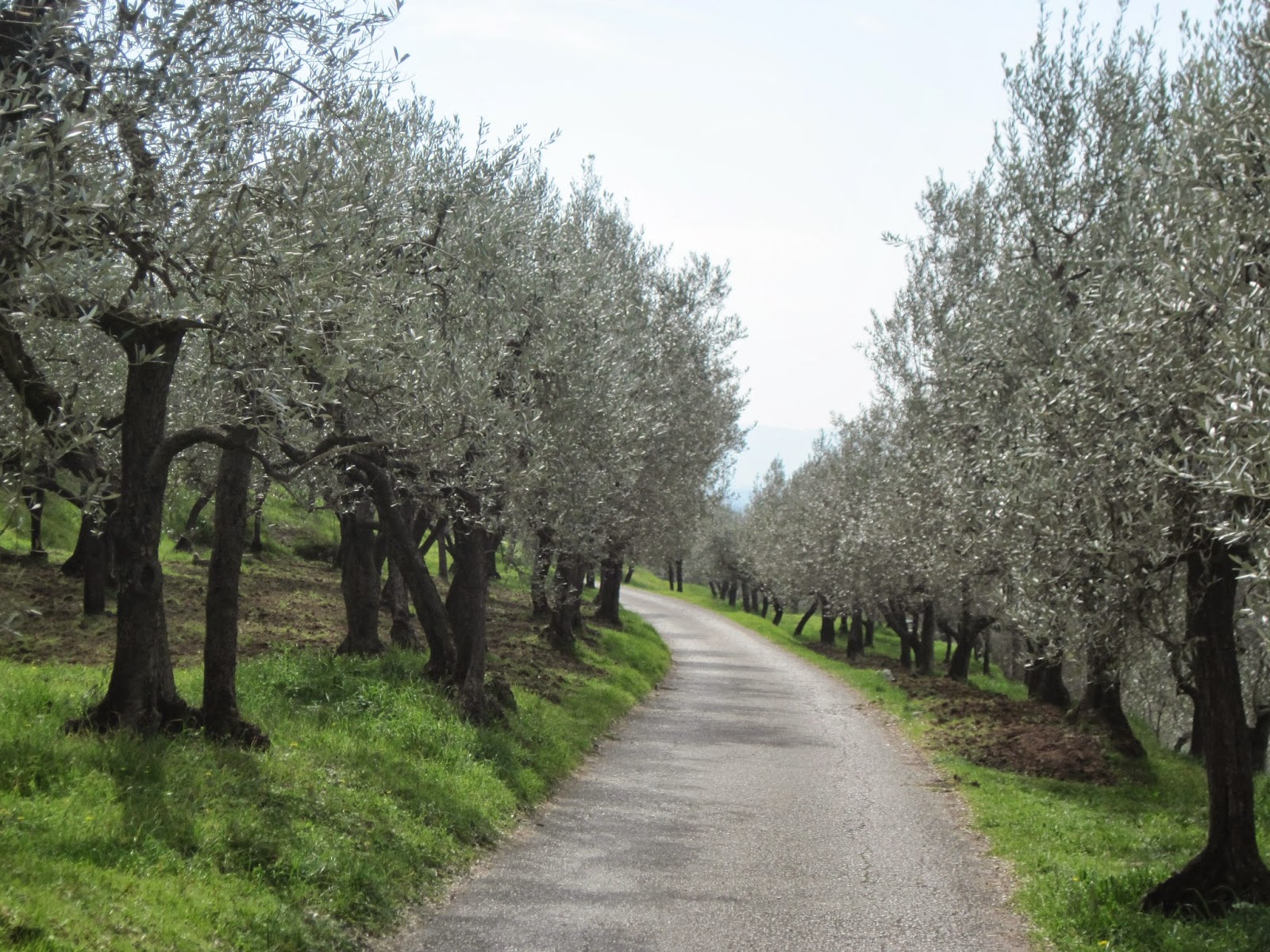
Nearby is a peaceful road called the Way of the Olives.
In the category of Italian Garden Folk Art.... I'm reminded of Groucho Marx attempting to explain a viaduct to Chico, and Chico asking, "Why a duck?"
The "Why a duck?" leads to the recently repaired Roman aqueduct that runs between Collepino and Spello. In walking along this two thousand year old engineering gem, one notices that the restorers added intermittent bon mots from more recent times. For example,
Trans: "A day without smiles is a day lost."
For animal art lovers, near Spello I heard barking, but saw no dog, until looking up.
Finally, an "unselfie". This is not me, not sitting in a favorite sunny spot in Assisi, by the Church of San Stefano, enjoying a chocolate gelato.
Ciao.

Friday, March 14, 2014

About Town

Settling in after much travel has meant walking down to Santa Maria degli Angeli to stock up on food and enjoying shorter walks around Assisi. Last evening provided nice light for a picture of the tree growing atop the San Giacomo gate. I've seen a picture of a postcard from around 1900, perhaps earlier, with no sign of a tree. However, in a 1920 postcard it is quite visible, supposedly having sprung up on its own and survived nicely, despite the elements and the uncertainties of time and history passing under it.
Below is a view of the brick walkway connecting Santa Maria degli Angeli and the Basilica of Saint Francis in Assisi, built with donations from thousands who have their names engraved on individual bricks.
It's a fine way for first time visitors (traveling lightly) to approach Assisi, an uphill climb with wonderful views, even on hazy days.
In and around Assisi one encounters many small shrines, ranging from the simple to the detailed, some quite artistic, others with beautiful flowers. Two caught my eye this morning, the first portraying Francis taming the wolf of Gubbio.
The second a more contemporary image of Mother and Child.
Of course, there are other fine things in Assisi that also catch the eye.
It's nice just strolling about town; but, with good weather in the forecast, some walking adventures are on the horizon.
Ciao.

Thursday, March 13, 2014

Buongiorno from Assisi

After a 25 hour journey that included flights from California to Washington D.C. to Fiumicino Airport, a train into Rome, a train to Foligno, a train to Santa Maria degli Angeli, a bus to Assisi and a walk past the childhood home of Saint Clare, I arrived at my home for the next two months on a sunny Umbrian afternoon. One might observe, cheerfully, that but for missing the Foligno connection due to a train delay, it would have only been a 24 hour journey. However, when one arrives to springlike weather in Assisi, the challenges of a long trip just melt away. Now, after a good meal at Pizzeria Otello, a good night's sleep and a fine morning stroll back down to Santa Maria degli Angeli, the world is looking quite beautiful again. Here's a window view from where I'm staying.
That's the fountain in the Piazza del Comune below, the center of town. It's approximately 87 steps down (or up), for those who enjoy exercise, or perhaps offsetting the impacts of frequent trips for gelato. Here's a view from the opposite direction.
Home-away-from-home is the upper set of green shutters.
Am heading out now, with much to do, but will be posting more soon. Ciao.

Tuesday, February 18, 2014

Traveling to Umbria

Beginning March 12 I'll be in Assisi for two months. I'm looking forward to hiking Mount Subasio and the Umbrian countryside beyond, and posting about some of many treasures in and around Assisi. Hope you'll join me!

Tuesday, May 28, 2013

Ancient Olympia

The ancient ruins of Olympia can be reached by taking a ten euro round-trip train ride from the Greek port of Katakolo. The train ride is slow, but comfortable and interesting as it passes through small towns and sweeps through areas of dense growth in approaching the modern town of Olympia, a short walk from the archeological site. My anticipated return train never showed up, but another one came an hour later. Going early is probably wise.
The archeological site is interesting, if not very imposing, upon entering.
However, as soon as one becomes oriented and starts to appreciate all that occurred here from 776 BC, when the first Olympics took place, up until current times, when discoveries are still being made, the area becomes fascinating to explore. This column of the Temple of Zeus, home of the Statue of Zeus, one of the Seven Wonders of the Ancient World, was reconstructed for the 2004 Olympics.
The gold and ivory statue of Zeus has been missing for about 1,500 years, perhaps awaiting future discovery. Ancient Olympia's stadium has an entry way for athletes not unlike the tunnels from which today's athletes emerge.
As a runner, I could hardly resist running the length of the field, and was not the only person doing so.
Not often one gets to run on a 2,789 year old course.
These are remains from the Temple of Hera.
These columns are from the Philippeion, constructed by Philip II of Macedonia in 338 BC to celebrate military and athletic victories.
Here's another view.
One of the more interesting recent (1954-1958) discoveries is the workshop of Phidias, who created the Statue of Zeus (432 BC).
Here are some interior views.
 
Again, in these rooms a wonder of the ancient world was created.
In the Fifth Century, the workshop was transformed into an early Christian church. The rounded apse is visible in this exterior view.
A couple more views of ancient Olympia, home of the Olympic games between 776 BC and 394 AD.
Looking to the sky.
Walking back to the train station one passes through modern Olympia, a well-maintained tourist town.
Where one may consider wonders of the modern world.
Ciao.

Monday, May 27, 2013

Walking About Mykonos

The town of Mykonos, on the Greek island of the same name, is an intricate maze of interesting walkways, where one is almost bound to get slightly lost, and to enjoy doing so. Hardly a single street is without charms.
Most of the walkways are quite narrow.
Here's another one, with dining tables.
Some of the wider streets allow traffic.
The above truck encountered another vehicle coming in the opposite direction, whose driver very carefully turned off on a side alley to allow passage. Mykonos also has no shortage of stairs.
These steps have their own display window.
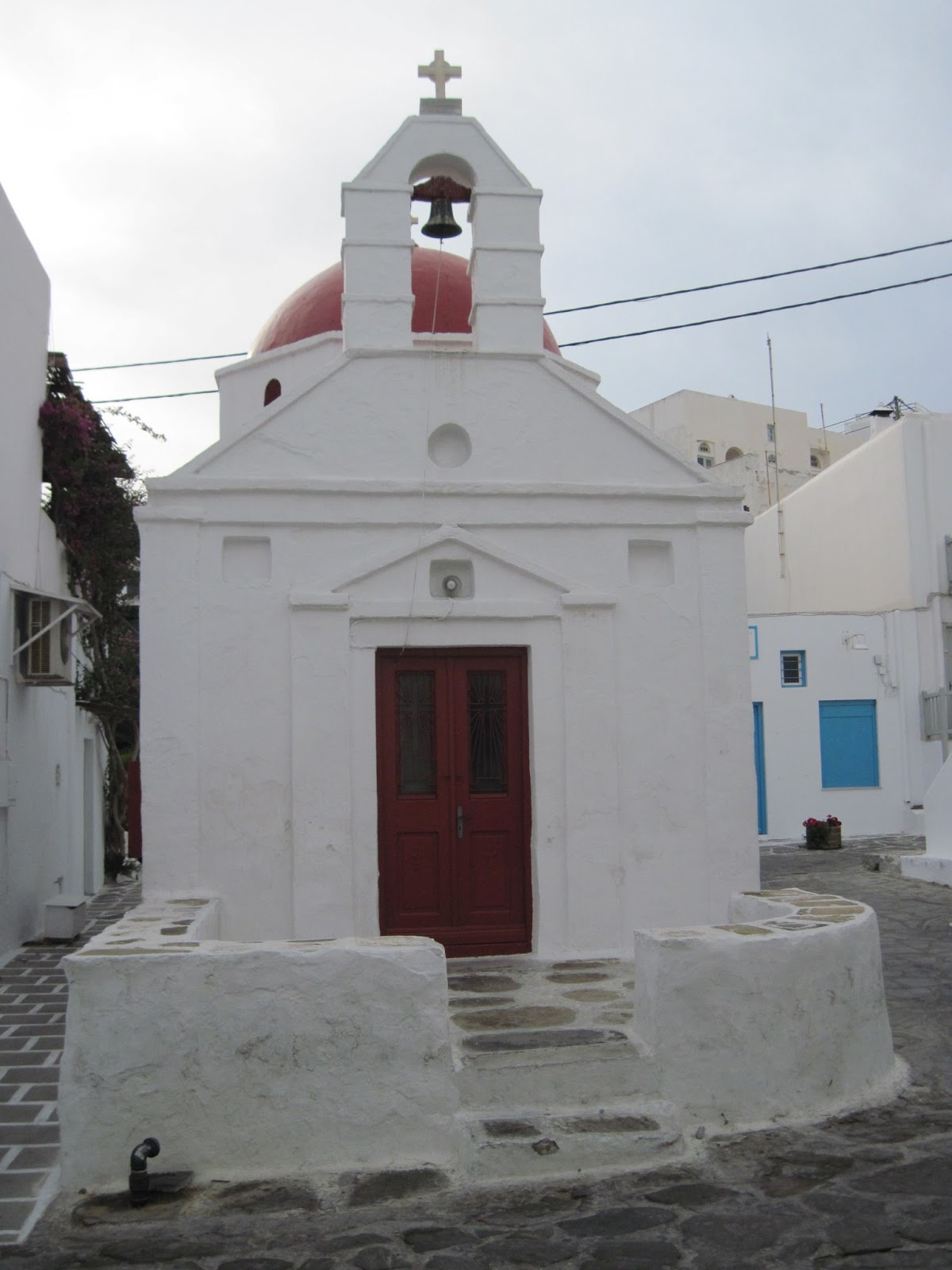
Small Orthodox churches are found throughout the town.
This one is well decorated with flags.
Some are stark white and simple in their design.
Save for the pleasant climate, one might think these constructed of snow by Eskimos.
A glimpse inside a Catholic church.
Perhaps the most popular images of Mykonos are of its old windmills.
Here is one standing alone.
There is a section of town referred to as "Little Venice." It has not just the narrow walkways of its namesake, but a row of structures sitting on the water.
Also as in Venice, many people beautify their narrow stone neighborhoods with flowers.
Another flowering of colors.
Even the old and worn sections of town have their charm
A pleasant home with the benefit of shade trees.
And, finally, a reflection of Mykonos, with flowers.
Ciao.