Monday, March 30, 2015

Wandering on Mount Subasio

I've been back in Assisi for a few weeks now. Following some recent heavy rains the skies cleared and the winds calmed, an invitation to an early Spring hike on Mount Subasio. With no definite plans other than avoiding trails that were bound to be muddy, I set out early in the direction of Fonte Maddalena, a vigorous climb along an old dirt road. The aged fountain appeared about as sturdy as ever.
 Add a bit of sunshine to the rain and wildflowers appear, far many more than just a week earlier.
After covering some switchbacks, I picked up Trail #61. This trail begins in Costa di Trex and goes to the summit. It's well-marked if not well-worn, probably due to fewer numbers of hikers starting from a rural hamlet. It was muddy in places, but quite passable.
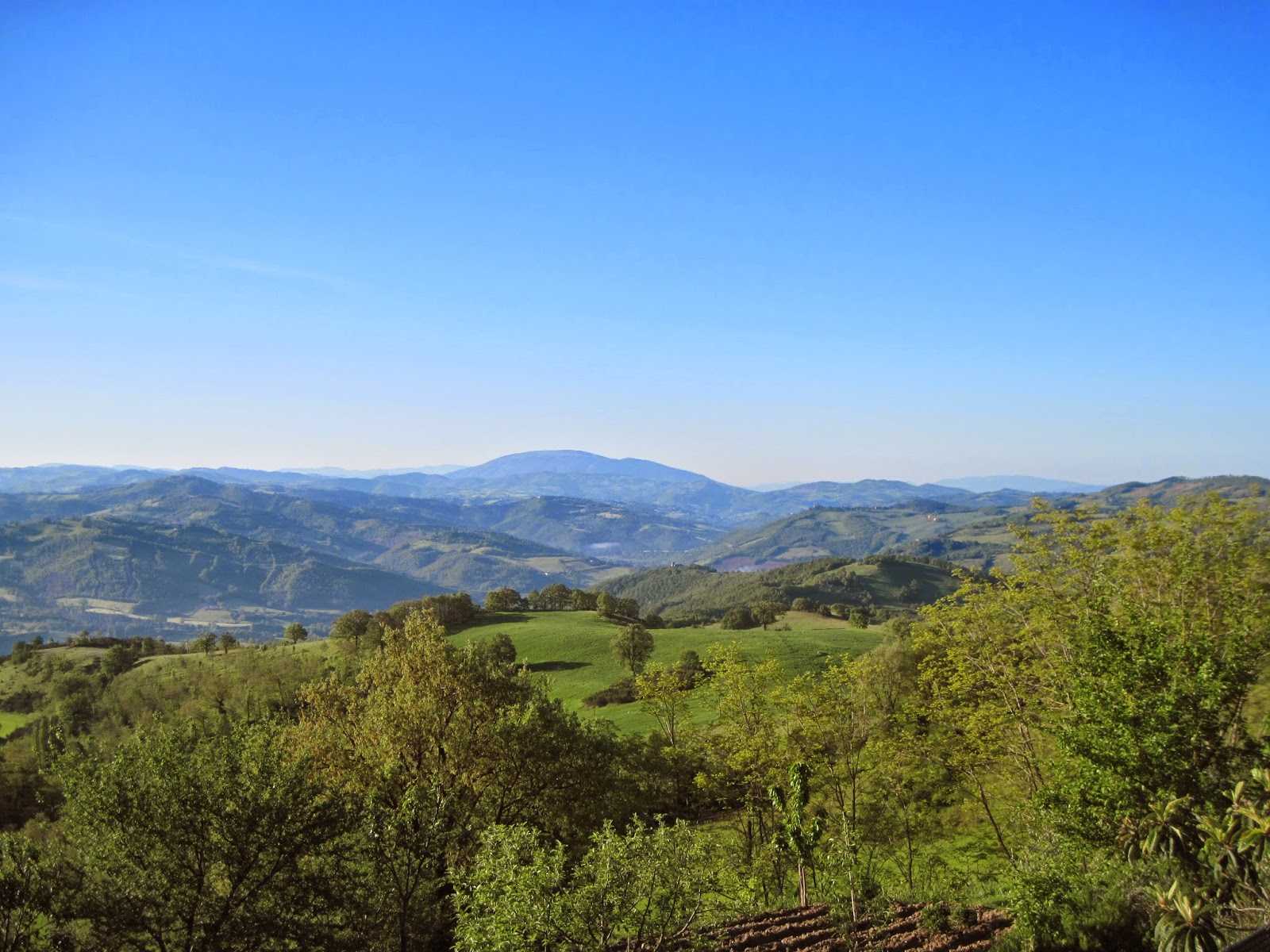
Above the tree line, the already excellent views improved.
After a visit to the summit of Subasio, next stop was Mortaro Grande, a large naturally formed sinkhole, once used as a place to compress snow and store it as ice for the warmer months. It's over 900 feet wide and almost 200 feet deep.
Here's a closer angle. Those who hike to the bottom, a steep descent, sometimes assemble rocks to create art or messages.
 Here's what a mortaro looks like from the bottom up.
Next I started down on Trail #50 in the direction of the Eremo and Assisi. More hikers and some mountain bikers were about at lower elevations. Passed through an area near the Rifugio di Vallonica where many horses were grazing.
Old and young were enjoying the fine weather.
 Had to share the trail with this one.
 Nice to see families out enjoying Subasio in the springtime.
Ciao.

Saturday, March 21, 2015

A Quieter Venice - Part II

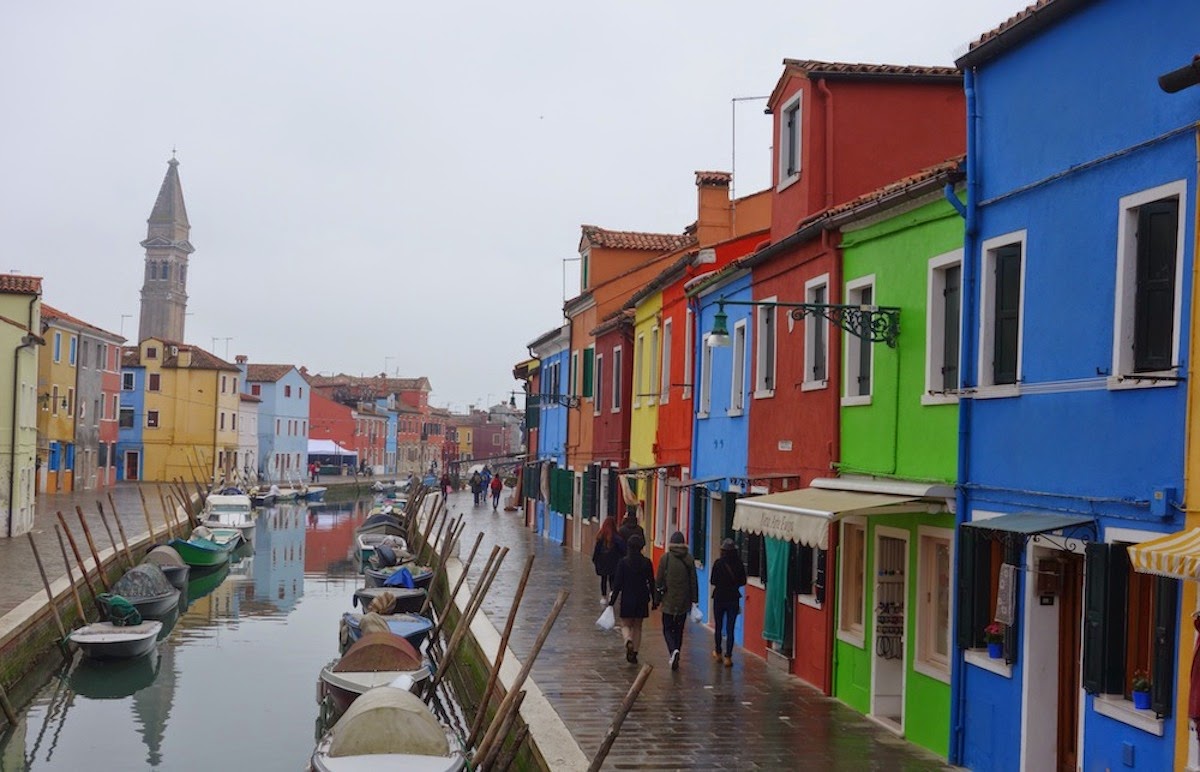
Continuing to seek out some of Venice's quieter locations, there are times when the islands of Burano and Torcello are not crowded, making it easier to appreciate their beauty and history. Here are a few images of colorful Burano.
 Colors that reflect in the canals.
This trattoria has a decaying sign with a metal sculpture of grapes. The grapes were so well formed they seem real.
Burano's streets of water flow out to the Venice lagoon and the sea.
Not far from Burano is the island of Torcello, one of the earliest Venetian settlements. One walks along the side of a canal to enter this small community.
There are many artifacts about town ranging from ancient to simply old, from the sacred to the just curious. This image of a holy person is one of many depictions attached to a brick wall.
Here is an old well, not unlike those found throughout Venice.
Does this unusual statue depict a mischievous person, a beggar, a saint or someone else?
A pair of shutters left ajar.
Not everything in Torcello is so worn by time. This view looks through the window of a shop filled with an interesting mix of old and new creations
Back to the center of Venice. Looking up, up from the crowds of tourists in and about Saint Marks's Square, one sees shadows of statues.
And a bit higher, the statues themselves.
They continue on, behind a lamppost.
And still looking up, under an entry to the Church of San Marco, one finds beautifully detailed tile work.
With so much art and architecture and history, it's no wonder so many travel to Venice. Yet daily life in Venice goes on as in the rest of the world. Here, the search for warmth on a mostly sunny winter day draws people from the cold canals and dark alleys to places of light.
Ciao.

Thursday, March 19, 2015

A Quieter Venice - Part I

With millions of Venice visitors, there is no shortage of photos of Saint Mark's Square, the Rialto, the Bridge of Sighs and other famous locations. The following pictures are mostly from less crowded spots, quiet campos, the outer islands, and lesser canals. Also included are a few easily missed views from main walkways or waterways.
Not every canal is Grand, but each one is vital in a city with streets of water. Notice how the Venetian flag sits above the Italian flag, not surprising when one considers Venice's thousand year history of independence versus its brief century and a half as part of a united Italy.
And the lesser canals that wind through the inner parts of the city hold their own simple, special attraction.
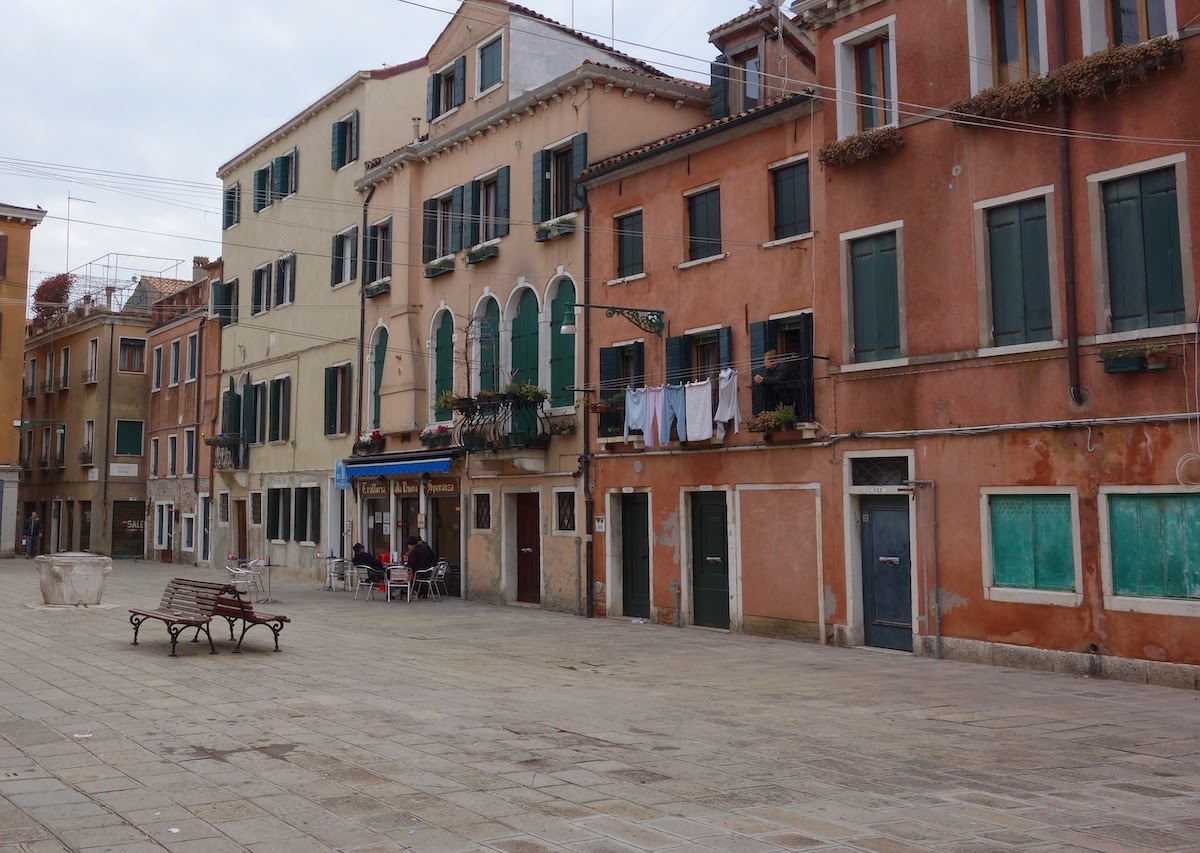
Some of the quieter campos, like this one, are found in the Castello sestieri, or section, in the eastern part of Venice.
These windows look over the Campo Do Pozzi (two wells).
Pisa may have a leaning tower, but so does the Church of San Pietro di Castello.
 It's not difficult to discern residential parts of Venice on laundry days.
 Here, in the neighborhood east of the Arsenale, Venice's old shipbuilding area, is a unique door.
Close by is the local Communist Party Headquarters, marked by a red flag, a religious shrine, laundry, pigeons and, inside, a picture of Che Guevara. (Not exactly the combination one is likely to find in other communist hotspots)
Those familiar with the movie Pane e Tulipani might recognize this small shrine near the Campo Do Pozzi.
Venice has many sotoporteghi, or walkways that pass under buildings. Above an entry to one in the Arsenale area is an interesting combination of an angel and two hedgehogs, perhaps symbols from a family coat of arms.
Here's a peaceful neighborhood walkway.
Out over the water, people visit along the Grand Canal.
A row of posters silently announce upcoming events, from opera to concerts and other stage performances.
Meanwhile, back in a bookshop window, a cat calmly studies a framed print.
While a man with a hat shop sits behind a desk amid his wares. Can you find him?
Hope to post Part II in a day or so. Ciao for now.

Friday, February 27, 2015

Finding Contessa Tagliapietra

There is a legend in Venice about a lovely girl named Contessa Tagliapietra. She was born in 1288 and died after a long illness in 1308. Her family lived here, in Campo San Vio, along the Grand Canal.
Actually, her home was in the foreground of this picture, closer to the old covered well and the canal, and was torn down in the Fourteenth Century.
Contessa, who apparently gained her title based on her family's role in a war with Genoa, was very devout as a child. She would often cross the Grand Canal in a gondola to pray in the Church of San Maurizio, located on the opposite side. Her view of the San Maurizio side of the canal would have appeared somewhat like this.
As she grew older, her father became concerned that his daughter might be too devout, which could impact the marriage he hoped for her. Unable to dissuade her from her frequent trips to the Church of San Maurizio, he finally instructed all of the nearby gondoliers to refuse to transport her.
Thus, the next time that she set out to cross the Grand Canal to pray, every gondolier she approached denied her request for a ride. Finally, she went to the edge of the canal, took a linen cloth and, stretching it out on the water, stepped onto it and floated across.
There's more to Contessa's story, filled with debates on miracles and myths, cults and devotions. For centuries Venetian mothers would set their infants over the entombed remains of Contessa, praying for their safety in avoiding drowning in the canals.
For some time I've wondered what eventually happened to the remains of Contessa. As noted, her home is no longer standing, nor is the original San Vio Church, where she was first interred. Past writings indicate her remains were next carried to the San Maurizio Church, which was later rebuilt. However, the reconstructed San Maurizio Church eventually was deconsecrated and now houses a beautiful collection of antique musical instruments. Here's what it looks like today. (Pay no attention to the unrelated protest going on out front, or the leaning bell tower from another church in the background. These things happen in Italy.)
While there seemed little question Contessa's remains were moved from San Vio to San Maurizio, what happened next? Were they moved again? And, if so, where?
Needing to start somewhere, I visited the musical instrument museum, and was pleased to see several works of art and engravings from the old church intact. Although the former sacristy was locked, one could look through a glass window to what appeared to be an area for repairing or cleaning old instruments.
However, there were no obvious signs, art or engravings referring to Contessa.
Before leaving, I approached the museum curator, who offered a word of greeting. At the risk of posing what might seem a very curious question, I asked him, as kindly as possible, if he knew of the story of Contessa Tagliapietra. Our conversation, partly in Italian, partly in English, went something like this.
"Hello."
"Hello. Please, I speak little Italian, but do you know of the story of Contessa Tagliapietra?"
"You ask, so I am wondering, do you know the story of Contessa?"
"Yes, I do, how she floated across the canal, and I am wondering what happened to her remains."
"She is here!"
"Ah!"
Recognizing my surprise and interest, he momentarily left his post and led me back through the old church to the sacristy door. He pointed through the window to what appeared to be a small white marble altar, reliquary or tomb, dark on the front, with wind instruments, a statue and some type of box on top. Within the tomb, he said, are the remains of Contessa Tagliapietra.
I hope to write more about Contessa in the future. For now, it's nice to just think of her floating through Heaven as she once floated over the Grand Canal.
Ciao.

Thursday, February 26, 2015

Italy 2015

I arrived in Venice on February 25, and will be in Assisi from March 7 to May 6. Hope to be doing some posting, so please check back.
Ciao.

Wednesday, May 7, 2014

Walking from Gubbio to Assisi

Saint Francis used to walk between the Umbrian towns of Assisi and Gubbio. His most notable journey occurred after he returned his earthly possessions to his father, intent on following his "Father in Heaven." It's a walking distance of about 50 kilometers (31 miles) between the two towns. Although no one knows for certain the routes he followed, there are a few different trails that seek to capture the spirit and experience of a young Francesco.
The trails often overlap, generally are well-marked, sometimes are not, and weave in and out of the countryside enough that one certainly experiences paths Francesco might have chosen. And it is all rugged, beautiful and inspiring.
A very kind person gave me an early morning ride from Assisi to Gubbio, where I began a walk back to Assisi at the legendary spot where Francesco tamed the wolf of Gubbio, the small Chiesa di Vittorino.
Surprisingly, at 5:30 a.m. the church was open.
The  early going was a straight and level country road out of town, a chance to leave behind a few of those kilometers. This was the path ahead, and the hamlet of Ponte d'Assi.
Finally, the climbing began, along with the good views back.

The higher the climb. the better the views. Here's one of the last looks back to Gubbio.
Interestingly, not long after Gubbio disappeared from sight, Mount Subasio appeared in the distance, although Assisi wouldn't be visible for many hours.
The trails include everything from paved roads, to gravel roads, to dirt roads, to maintained paths to challenging combinations of rocks, mud and water. Fortunately, most sections were quite good for walking.
Far from the nearest town, deep in the woods, is the small chapel of the Madonna delle Ripe.
It was gated closed, but the interior could be seen.
At about 17 kilometers is the hermitage of San Pietro in Vigneto, an imposing, enclosed structure with a small sign saying "No Visitors".
However, by the gate is posted a daily schedule for its occupants.
Things went smoothly for most of the hike. Where two or more trails converged, it usually wasn't difficult to find the way.
However, at about 20 kilometers there was a spot where the only marker in sight was a green arrow painted on a rock on the ground. In time it became clear that I had missed a turn for the red/white trail, and was now on a less traveled path. Eventually, there was a sign pointing the way forward, but that led to a long and wide stretch of mud, bound on both sides by dense brush. The mud worsened where streamlets flowed through. From the surrounding hills, the sun and the water flow, it seemed this was the right direction, south, traveling parallel to the Chiascio River. However, the mud went on and on. Finally, there was a stretch so deep that trying to pull a foot out resulted in a fall to my knee. In the spirit of Saint Frances, undoubtedly this was Fratello Fango (Brother Mud) reminding me to fall to my knee in thankfulness for a beautiful day and a safe hike. Soon after, the trail improved and led to dryer ground. 
(While people may debate the exact routes Francesco walked, I think it probable that he did not walk the Chiascio mud flats during the Spring, else instead of being Francesco d'Assisi he might have been Francesco del Fango.) 
A rising trail confirmed the Chiascio was close by.
Then the river became more beautiful, viewed from afar.
After about 7 kilometers of uncertain wandering, the main trails came back in view. From there, it was uphill to the Chapel of Sambuco.
After a long stretch of woods, the trail opened up more wonderful vistas, like this one looking back over many miles walked from those distant hills. 
The trail was leading closer to Valfabbrica, the only town of note along the route. It passed by the Chiesa di San Benedetto.

No keypad entry here.
Despite having not rained for a couple of days, the trail was still wet in numerous places. Any potential hikers would be wise to not tackle these trails during or shortly after heavy rains.
Soon Valfabbrica was in sight. Entering town meant crossing over the Chiascio River.
A short walk through town.
Then, on to the last segment of the hike, through a cute little hamlet named Il Pioppo, that ends almost as soon as it begins.
Finally, after another steep, muddy, trail climb, Assisi came into distant view.
The last few miles were mostly a pleasant downhill stroll through forests and farms, until reaching the road up to Assisi. The road offered good looks back at the last stretch.
And then, entering through Assisi's Porta San Giacomo.
It was about a twelve hour walk, usually at a brisk pace (considerably slower in muddy sections), stopping briefly to visit sites along the way. Often pilgrims take two or more days, staying overnight in Valfabbrica, and there's no shortage of exploring to do with more time. Some additional advice to those considering a hike: the various trail markers are usually dependable, but some are missing or worn out and some list conflicting distances. What you can be sure of is that there are two towns called Gubbio and Assisi, with a place in between that would be hard to miss called Valfabbrica. Beyond that, be prepared for an adventure. As you wander through the beautiful Umbrian forests, so peaceful and inspiring, it's easy to imagine a young Francesco coming along from the other direction, but for a brief difference of eight hundred years.
Ciao.