Sunday, May 26, 2013

Santorini: Visiting Fira

The Greek island of Santorini took its current form some 3,500 years ago with a major volcanic eruption that resulted in the volcano's crater sinking to the floor of the sea. The volcano is still stirring today, as life goes on in towns built on a base of lava. Approaching by sea near the town of Fira, one sees the white buildings atop the cliffs.
Drawing closer, one begins to distinguish the routes up to Fira.
To climb to Fira, one may ride a cable car, ride a donkey or walk. The downside of the cable cars is one may find oneself in a long line waiting when it's time to come back down. The downside of the donkeys? Depends on what kind of a day these guys are having.
Now, walking has no downside, other than having to share the walkway with the donkeys. For different reasons, both donkeys and humans are well advised to watch their step.
At a brisk pace it takes about twenty minutes to reach Fira on foot. Needless to say, the fine views along the way only get better atop this volcanic rim.
Here's a closer view looking down on Fira.
It's a town of white buildings, blue sea and sky.
Another view.
Eating out on Santorini means eating out, literally.
The Orthodox churches in Fira are beautiful in design and artwork, including this mosaic.
There's also a Catholic Cathedral, and the name "Santorini" is derived from Saint Irene.
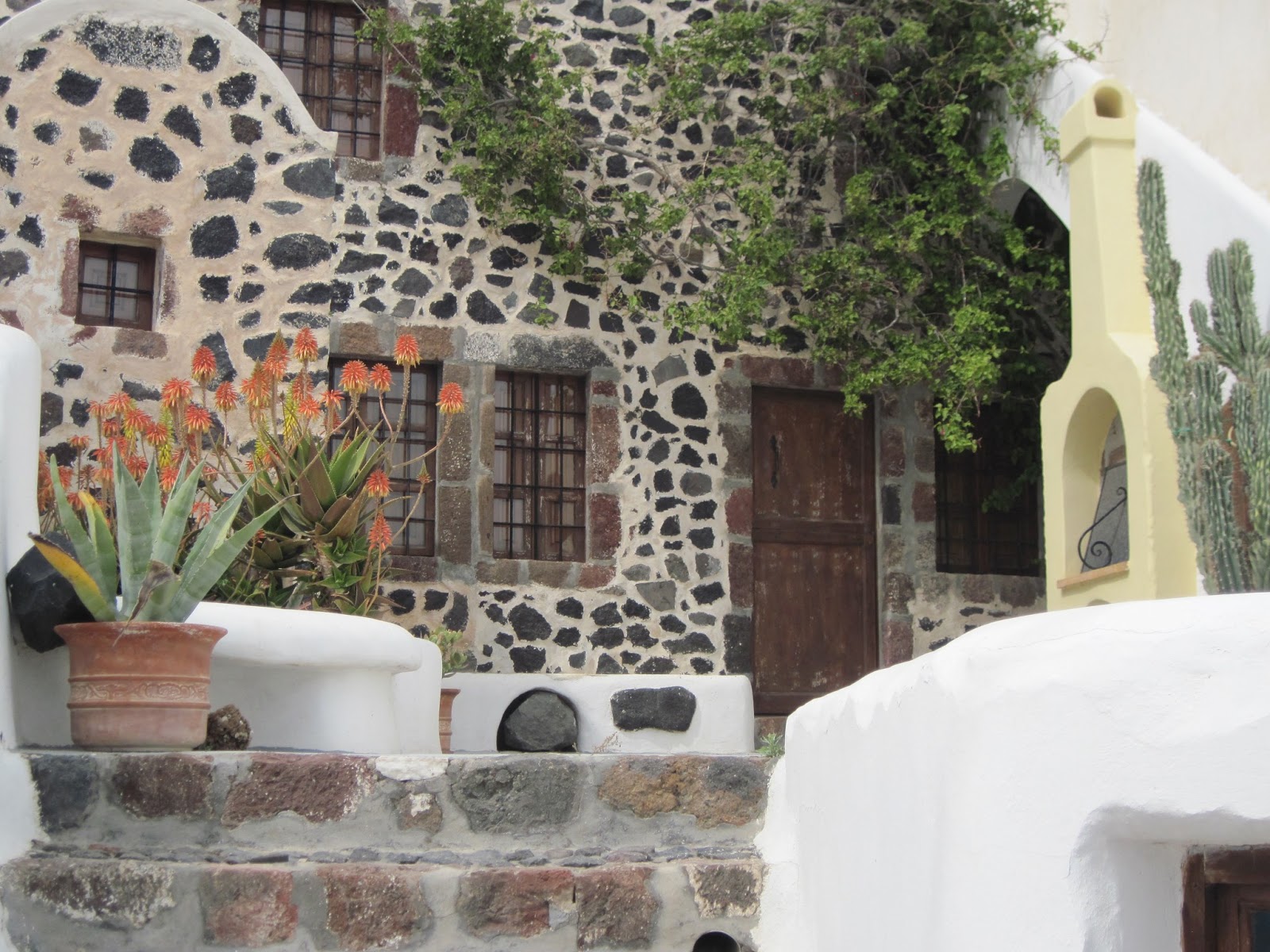
The climate on Santorini is so ideal, doorways often lead from the outdoors to... the outdoors.
An older door from and to the outdoors.
Most of the homes are beautiful in simple white; although some are more creative in design.
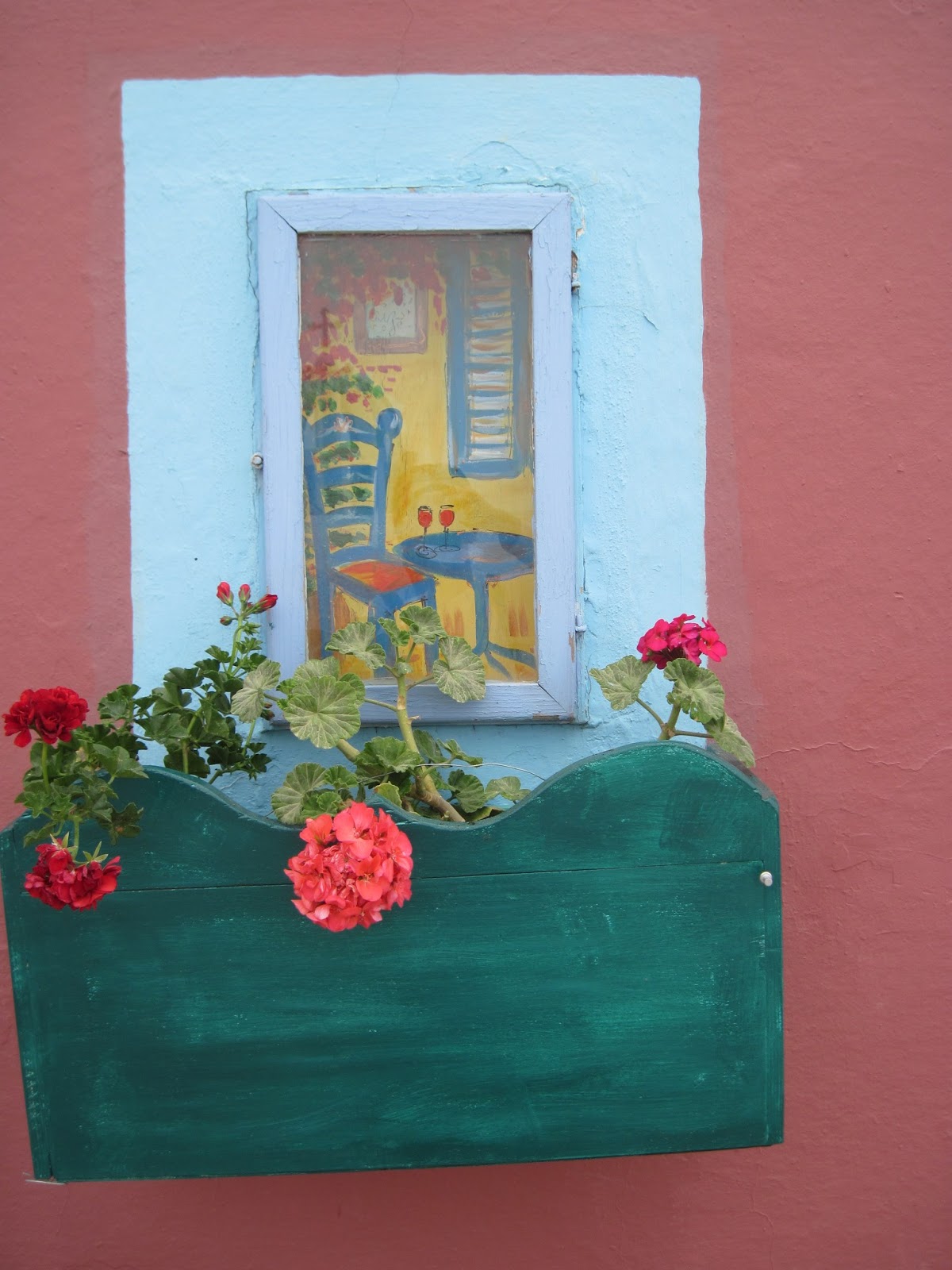
Santorini thrives on tourism and has its share of souvenir vendors. Still, it's an inspiring setting for artists to set up shop.
And decorate walls.
In approaching by sea, one is drawn to the whites and blues of Santorini. Once there, ones vision is drawn back to the sea and sky.
After a few miles of walking I came across what looks like a part of the Grand Canyon stretching off this Greek island.
Hope to walk out there in the future. For now, a glimpse of a Santorini sunset.
Ciao.

Saturday, May 25, 2013

Venice: A Short Gondola Ride and More

For tourists a forty minute daytime gondola ride costs 80 euros, or just over $100, with a maximum of six passengers. Evenings are more expensive. However, gondolas also still are used by locals as a means of crossing the Grand Canal.
There are small docks at the end of certain alleys where passengers board and take the approximately two minute ride across the canal. Many don't even bother to sit.
As is seen, there are two gondoliers. Here's a close up of the lead one.
A slightly askew view from part way across.
And a return crossing without passengers.
Locals pay about 70 euro cents to ride; all others pay 2 euro.
Before leaving Venice, here are a few more pictures from around the city. First, some carnevale masks in a store window.
Next, building facades along a typical street.
Homes and buildings often have small shrines, statues or other images on the walls.
On the side wall of a church, I believe the Church of San Samuele, is this ornate design.
A closer look at the bottom calls for a donation: "Bread for the Poor."
Next, a building façade along the Grand Canal.
An art supply store, with a selection of colorful pigments on display.

Finally, a cloudy view from the Accademia Bridge over the Grand Canal.
Ciao.

Friday, May 3, 2013

Venice Fog

Went for an early walk this morning and a light fog had settled over the city. Started out on Via Garibaldi.
Crossed near the Bridge of Sighs.
Then to Saint Mark's Square.
Here's a wider view of the Square.
A little early for a gondola ride.
Passengers will arrive in just a few hours.
No cars in Venice, but certainly parallel parking.
Ah! A ghostly apparition of a gondolier.
Looking down a narrow canal.
And a wider one.
And the Grand Canal.
Back to traveling tomorrow, this time cruising the Eastern Mediterranean. Again am not sure if or when I'll have internet access or time for posting. However, I'll be taking pictures and hopefully will have them posted sometime in May. Grazie for reading and...
Ciao.


Thursday, May 2, 2013

East Venice Neighborhoods

The main "island" of Venice is actually some 118 islands connected by footbridges. People generally arrive on the west side, either by sea or by crossing a long bridge in a train or other vehicle. Cars, trucks and trains go no further than the western edge. As a result, the crowds are heavy near the bus and train stations, and remain heavy going eastward along the Grand Canal, all the way to Saint Mark's Square. Between Saint Mark's and the more eastern section of Castello where I'm staying, there are seven footbridges over canals. The first one becomes almost impassable at midday, as people vie for views of the Bridge of Sighs. The second and third also are very busy, but then the foot traffic starts to taper off, and by the time one crosses bridge number seven to reach Via Garibaldi, the danger of being swept away by massive tour groups is greatly diminished. Still further east is Sant' Elena, which is actually a part of Castello.
This post leaves behind the crowds to provide a glimpse of eastern Castello, a more residential part of Venice. However, it's not all residential. Close by where I'm staying is Arsenale, Venice's historic shipbuilding complex, started some nine centuries ago. It was the largest industrial complex anywhere before the industrial revolution. While its history of military might is long past, it still has an imposing main entrance.
Here's a closer view.
The Arsenale is just over a canal from the end of my alley. Going in that direction and then turning left to walk along the canal, one encounters this corner enterprise.
The local chapter of the Italian Communist Party. There appeared to be some type of social(ist?) event going on when I first noticed it. I snapped this picture, then had second thoughts, but decided my red day pack and Red Sox cap probably muddled any assumptions about where my sympathies might lie. Here's a second picture taken later. There's a Che Guevara poster inside, and there's also a nice shrine on the front wall. It may be that religious, social and political lines are drawn quite differently here than in the U.S.
Looking down on that same canal, a delivery boat is passing by.
Note, in the picture below, the fellow pushing a metal cart. There is a distinct and pleasant silence along most walkways due to the absence of cars, trucks and buses... and garbage trucks. When one does hear a loud rattling noise along one's alley, there's a good chance it's a trash pickup cart like the one this fellow is commandeering. People set out their trash in small plastic bags (no room for trash cans), and workers pass by picking up the neighborhood. Once the metal cart is full, the trash is transferred onto a canal barge for removal.
Moving east toward Sant' Elena, one sees a rare sight in much of Venice: trees!
And where there are parks, there are bound to be statues. Not sure who this is, but where other than Venice would the subject be astride a lion?
Looking back, it's about a mile to Saint Mark's.
In the Sant' Elena neighborhoods the absence of vehicle noise is even more noticeable. One can hear another person's footsteps a block away. There are some pretty buildings here.
 Many decorate the outside of their homes with flowers.
A corner fruit and vegetable stand.
One probably would not want to stay this far out without a vaporetto pass, as it's a good trek to get to many of the tourist destinations. However, to see where many locals live and to escape the crowds, Sant' Elena is a nice place for a walk. Finally, people are not the only ones to enjoy the tranquility of this end of Venice.
  Ciao.