Friday, April 18, 2014

Assisi Good Friday Morning Procession

On Good Friday morning, following an early service at the Cathedral of San Rufino, the "Processione per il trasferimento del 'Cristo Morto'" or "Procession for transferring of the 'Dead Christ'" is held. It follows a roundabout route from the Cathedral to the Basilica di San Francesco, stopping at convents along the way.
It seemed there were about 500 people in the procession as we set out through Assisi's narrow streets.
Approaching the Basilica di Santa Chiara.
Here the procession is filing back out of the Basilica di Santa Chiara.
Some members of the "confraternite", or brotherhoods, carry crosses and walk barefoot.
The wooden image of Christ is from a 1561 crucifix by an unknown author. Its home is above an altar in the Cathedral of San Rufino.
Ahead is the center of Assisi, the Piazza del Comune. The former Temple of Minerva columns, seen in the center of the picture on this side of the bell tower, are over 2000 years old.
And then the procession passes through another part of town, stopping at the Convent of Santa Croce.
Soon, the Basilica di San Francesco comes into sight.
As well as the valley below.
Continuing down toward the lower church of the Basilica.
And then going in for prayers.
Pace e bene e ciao.

Thursday, April 17, 2014

Almost Easter

With Easter almost here, the "Pasqua in Assisi" events, services and processions are underway.
As if in anticipation, the days have become cool, crisp and clear, with enough wind to discourage brush burning. Thus, fine views across the valley. The Basilica in Santa Maria degli Angeli can be seen in the right center. On the distant hill is Bettona, a long walk but a fine old city to visit, with its roman wall.
Here, on the right, is Assisi's Santa Maria Maggiore, built over an ancient roman residence. To the left of it is the bishop's residence, where a young Francis returned his belongings to his earthly father to begin following his Father in Heaven. On the distant hill beyond the church is the City of Perugia.
A view looking up at the Rocca Maggiore from in front of the Basilica of Saint Clare.
Could hardly help noticing that even the folks with the Saint Francis - Saint Clare - Pope Francis display, from a few posts back, are now readying for Easter.
And the flowers are in bloom on time.
Finally, a view of Mount Subasio with the sun rising behind.
Ciao.

Saturday, April 12, 2014

A Glimpse of Assisi Art

Just a brief post today. A sign of Spring.
A few frescoes and paintings from centuries past from the Pinacoteca Comunale (municipal art museum) in Assisi. The first is the Martyrdom of Saint Stephen.
Next is a depiction of Saint Francis, part of a larger work by Puccio Capanna.
This is Saint Catherine of Alexandria.
And this, Saint Lucy.
And, surely, The Annunciation.
Finally, a morning view of Mount Subasio from the valley.
Ciao.

Thursday, April 10, 2014

A Church and a Cyclist

Two stories to share today, one of personal and the other of historical interest. First, a view from my window:
In the top left of the picture, a short distance away, is the dome of the Chiesa Nuova, or New Church, built over the childhood home of Saint Francis. I've posted about it before, showing photos of interior columns with frescoes that were painted over during a remodeling a few centuries ago, before being uncovered in the past year. The church is modest in size, despite the high domed ceiling.
On weekday mornings there is a 7:30 a.m. Mass, which is not held at the main altar. Instead, congregants pass through a low, narrow door into a small room with thirteen large, intricately carved, connected in a u-shape, wooden seats that, frankly, one might expect to see cardinals sitting in. That is where the congregants sit. There is one other bench, that could seat three, plus one chair for the priest, and a small table-like altar.
At about 7:25 a.m. I was in the back of the darkened main part of the church when a nun entered and walked past toward the narrow door. She turned and motioned for me to follow her for Mass, and we entered the little room and took places on two of the very imposing wooden seats. Altogether about nine people were there, including the priest and altar server. When the aforementioned nun stepped forward to do one of the readings, I finally recognized her. (Keep in mind, with thousands of nuns living and visiting in and around Assisi, rather than standing out in a crowd, often they are the crowd)
It was nice to experience Mass in an old, sacred and close setting. Afterwards, when Sister Alessandra (from Saint Anthony's in Assisi) came out the main door of the church, she remembered me as well, and extended an invitation to visit their convent.
I've searched online for a picture of the room where the Mass was held, to no avail. Perhaps that's how it is meant to be.
The second story involves events of about seventy years ago, during World War II, when Assisi secretly harbored many Jews during the German occupation. Some were hidden in convents, others in homes, and numerous people risked their lives to assist in this dangerous mission of mercy. Among them was a fellow named Gino Bartali, a well-known Italian cyclist who had won both the Tour de France and the Giro d'Italia. Because of his notoriety, the Germans generally left him alone as he cycled over the hills of Tuscany and Umbria, unaware that he was smuggling forged documents in his bicycle frame, documents needed to assist escaping Jewish refugees. He would ride with his name clearly spelled out on his shirt. He even hid a Jewish family in his cellar, thereby saving their lives. One time he pulled a wagon as he cycled toward the Swiss Alps, telling authorities it was part of his training, while failing to mention a hidden compartment and his mission of helping refugees escape. On another occasion he explained his efforts to his son in a few simple words, "One does these things and then that's that."
It's good to remember Gino Bartali and those like him, for their caring, courage and goodness.
Ciao.

Tuesday, April 8, 2014

Visiting the Rocca Maggiore

Overlooking Assisi is a fortress known as the Rocca Maggiore. It's origins may date back to the Eighth Century and the time of Charlemagne. However, in the Twelfth Century it was a seat of power used by various occupying forces, including Frederick Barbarossa, until in 1198 it was torn down by the people of Assisi, never to be built again. "Never" lasted for about 167 years, when it was rebuilt, to be added onto in the centuries that followed. After centuries of wars, tearing down, rebuilding, looting, repairing and general wear and tear, the Rocca has been partially restored and is well worth a visit. In addition to its interesting history, the views are terrific. Standing outside its walls, one looks up to see its "keep", the tower which serves as a fortress within a fortress.
To the west of the keep, at the far end of the wall, is a polygonal tower, added on five or six hundred years ago to keep an eye out in that direction.
Fortunately, these days it's not necessary to employ barbarian armies to gain access to the Rocca. For a reasonable fee one can gain access, and even the door of the keep is left open.
Once inside, one can start up the staircase seen above; however, eventually, climbing higher means ascending a circular staircase.
A very narrow circular staircase.
That goes round and round and round and round to the top.
At which point invading forces are too dizzy to do battle. The higher up views are great. This one looks over part of Assisi toward Monte Subasio.
And here, literally, is a bird's eye view of Assisi.
Inside the keep is an added treat. Each year in May, Assisi celebrates Calendimaggio, a multiple day event where townspeople dress up in Middle Ages costumes. Calendimaggio pictures from the past century have been posted on the walls. Here are a few of them.
Drummers in the Piazza del Comune.
It would appear that, many years ago, the Land of Oz sent a delegate.
Time to visit the polygonal tower. Getting there means first climbing circular stairs (a more recent version, replacing retractable ladders), then descending stone steps into the long fortress wall extending out to the tower.
It's a dark and narrow tunnel extending a little over 100 meters.
Then, up more stairs and suddenly one comes out atop the tower, with magnificent views, including this one of the Basilica of Saint Francis.
Looking back at the keep.
After enjoying the views, it's time to descend back into the tunnel.
Here's a view looking back at the polygonal tower over the top of the wall.
Spring has arrived, even on the Rocca.
Another view, with the keep seen on the upper left.
Finally, passing by another section of wall on the way out.
Good to visit the Rocca Maggiore on a clear day for the views, on an uncrowded day for the narrow passageways, and with enough time to read and explore with imagination while roaming about.
Ciao.

Friday, April 4, 2014

Assisi Walls

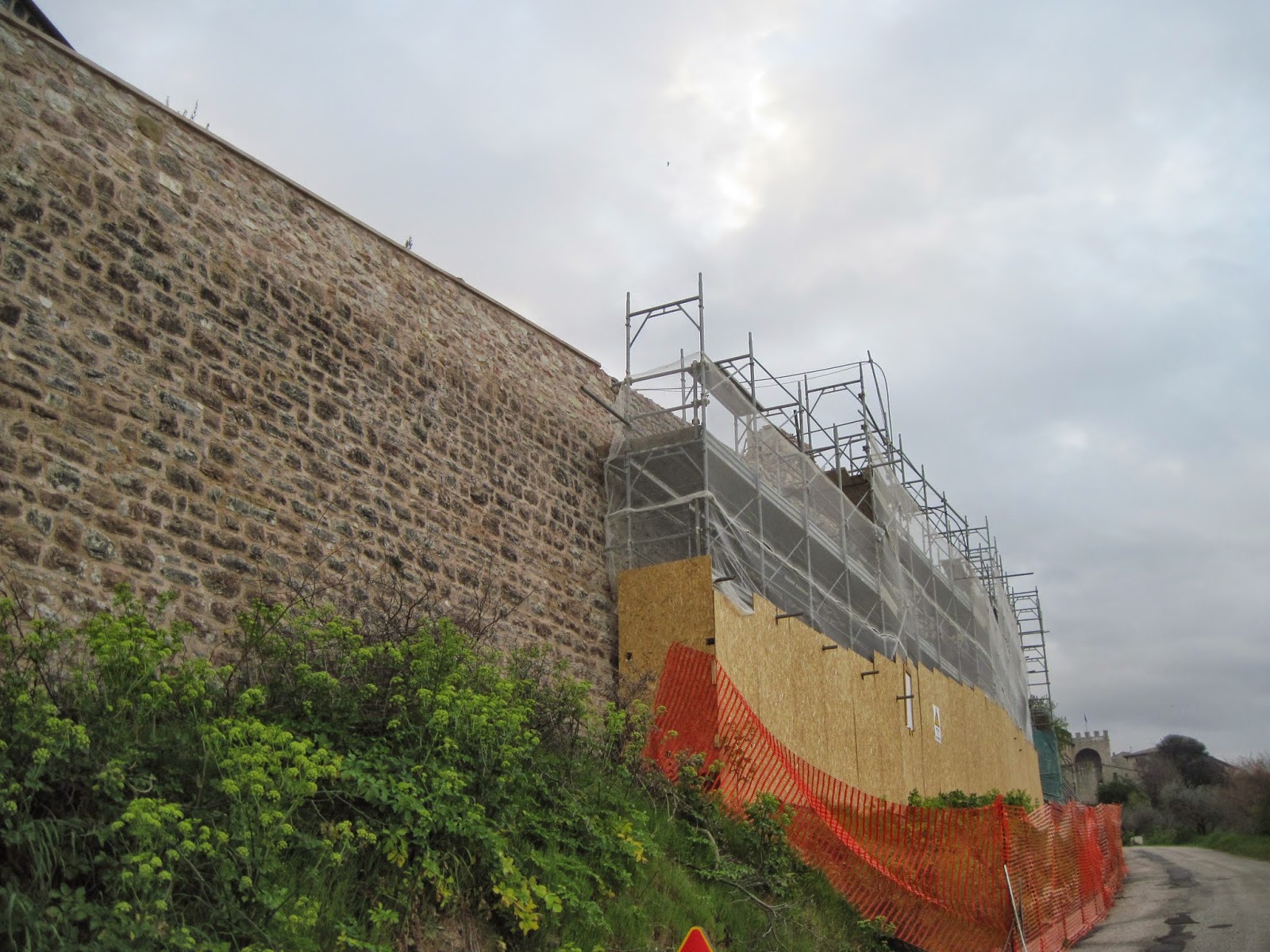
When the walls in your neighborhood are several hundred years old, there comes a time when they need maintenance. Below the Basilica of Saint Francis is one such wall.
Sooner or later, time and the elements take their toll, and no maintenance would mean no wall. However, just to the left of the above are some staging and workers.
And to the left of them is an "after repair" wall, good for a few more centuries.
Through much of Assisi one finds narrow streets lined by high walls.
Sometimes, light comes through a wall, as with this small window opening in the Church of San Stefano.
Atop many of Assisi's walls, of course, one finds roofs.
The roofs are often close together and interesting to view from above, after walking up many stairs.
In certain places, the walls are covered with posters. No need to translate this one.
Some people hang things from their outside walls, ranging from flower pots, to lanterns, to metal artwork, to small shrines. Most are beautifully decorative. The other day I noticed one that, well, sort of stood out from the rest.
Let's take a closer look.
That would be Saints Francis and Clare who, in their legends, are perhaps sometimes portrayed as larger than life, and Pope Francis, who, in his humbleness, would perhaps prefer not being portrayed as larger than life. (I hope that's a satisfactory explanation.)
Finally, for early morning cappuccino drinkers, a picture of Bar Sensei lighting up the wall on the main street through town.
Ciao.